Travels with Penelope

Travel, Food, Wine, Spirituality and Everything Else

Month: October 2014

October 27, 2014 Pittsburgh’s Strip


It rained early on my second morning in Pittsburgh, lightly but enough to give everything a good cleansing. I jumped up and down for joy, until I realized I was not in California home of the worst drought in 500 years. Coming from the Golden State, the green hills here seem outrageous. With water, water everywhere I did not feel guilty about running it when brushing my teeth. I’ve gotten a lot of questions from Pittsburghers about the drought. My only answer is, it’s time to bring out the drums, do the rain dance and hope that the goddess of rain smiles on us.

After breakfast the rain cleared; humidity set in and the gray-coated sky provided the perfect backdrop for Pittsburgh’s hills edged with its ubiquitous red brick houses and rivers whose yellow bridges line up like giant tinker toys against the mud-brown waters. The weather boded well for our plans to visit the Strip, and St. Anthony’s Church.

We would forgo the Andy Warhol Museum as we had visited it on previous trips. If for nothing else, the Warhol is a great read on his life and work and a reason to come to Pittsburgh. The Pittsburgh art scene continues to burgeon through other venues including The Miller Gallery at CMU, Pittsburgh Center for the Arts, Pittsburgh Glass Center, Pittsburgh Filmmakers and SPACE Gallery.

In spite of its provocative name, the Strip is just that: a half-mile strip of land sandwiched between the Allegheny River and a mountain-like hill. Warehouses lined with truckers picking up and delivering goods, a flower mart, and various industrial suppliers flank its side streets. A jumble of eateries, coffee houses and roasters, specialty groceries, bakeries, and a plethora of ethnic food stalls crawl along Penn Ave. catering to every known craving: kielbasa, pierogis, banh mi, pasta, and tacos, etc. simply presented, and cheaply priced.


IMG_0155


IMG_0182


IMG_0197


IMG_0161


IMG_0159


IMG_0158


IMG_0157


IMG_0151


IMG_5229


IMG_5224


IMG_5205


IMG_0207


IMG_0208


IMG_0210

It’s not a Church!


IMG_0211

It’s an Altar Bar!


IMG_5213


IMG_0181


I approached a stand where workmen were lined up for sandwiches. “Vietnamese?” I inquired. A customer replied, “I don’t know, but they’re awfully good. I come here all the time.” The Vietnamese woman behind the stand, famous for her sandwiches replied, “Yes, they are Vietnamese.” The Strip as a great spot for street food, just may be the Hanoi of America.


IMG_5214

Banh mi in disguise.


IMG_5211


IMG_5207


IMG_0156


IMG_0177


IMG_0180


My partner hungered for one of Primanti’s signature sandwiches. Fried sardines, tomatoes, pickles, onions, cheese and yes French fries slathered in mayo and mustard, squeezed between two slabs of bread large enough to feed a Steeler, filled the bill.


IMG_0185


IMG_0184


IMG_0187


IMG_0189


IMG_0196


IMG_0191

I did not inhale.

From the Strip we ubered to St. Anthony’s Church a museum of sorts in that it houses the largest relic collection in the world. “What is a relic?” An object that has survived from an earlier time of course, in this case, religious relics such as pieces of clothing, bones, drops of blood, ashes, or the personal affects of saints or venerated persons. Corporal memorials – they are saved for remembering and honoring a highly regarded being.

In 1880 Father Mollinger from a wealthy Belgian family, the pastor of Most Holy Name of Jesus Church initated the construction of a chapel to house his collection of relics. In his lifetime, thousands of people made their way to the chapel to receive his blessing and the relic of St. Anthony. Mollinger’s 5000 relic collection has been housed in the church for over a hundred years. They had been venerated in Europe previous to their transport to St. Anthony’s. Documents verify their authenticity. Included in the collection: a splinter from the True Cross, a thorn from the Crown of Thorns and a piece of stone from the Holy Sepulchre and many relics of first class saints.

Father Mollinger spent over $300,000 to provide the chapel located on Troy Hill on Pittsburgh’s North Side. When he died unexpectedly and having left no will, the Church acquired the title to the chapel. The Bishop settled with the family heirs for $30,000, a pittance of the original cost. At the time, the struggling parishioners of St. Anthony’s eventually raised the $30,000 to repay the Bishop.


IMG_0423


IMG_0424

Photos are not allowed inside the church.

My thought was that if the relics truly were the survivors of so many elevated and even enlightened beings, with 5000 pooled in the same room, the energy would be overwhelming. I anticipated the possibility of levitating and gliding through the church. My illusion was met by the silence of a morgue-like museum of unrecognizable bits and pieces of people from another time and age. I don’t want to be disrespectful, but I cannot deny my skeptical response to the idea of housing scraps from 5000 deceased humans in one room. What purpose do they serve save to placate our attachments and emotional needs? In some cultures, such as the Native American and in India, open-air cremations are allowed in which the fire consumes all traces of a body and releases the ashes back into the cosmos. My own father’s memorial card read, “Do not weep for me, in death I now surround you”. If you are reading this, I would be most interested in your thoughts.

Pittsburgh’s two trams up Mt. Washington have been running since the 1800s when they were originally constructed to transport steel. With the steel industry all but shut down today, they transport people up to the mountain-top where a bevy of restaurants lays waiting. Instead of using the tram, we treked up the mountain with Uber. We would dine at Altious with its unparalleled view of the Golden Triangle.


IMG_0337


IMG_0339


IMG_0334


IMG_0328


IMG_0329


IMG_0331


IMG_0340


IMG_0345


October 21, 2014 More to Pittsburgh than the Steelers


More to Pittsburgh than the Steelers?

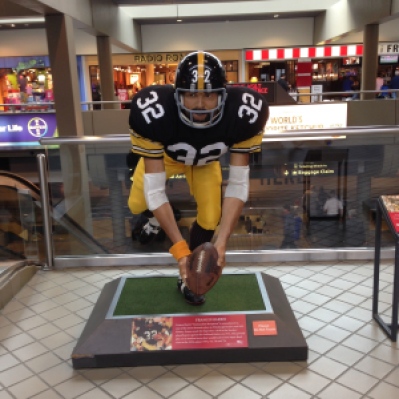
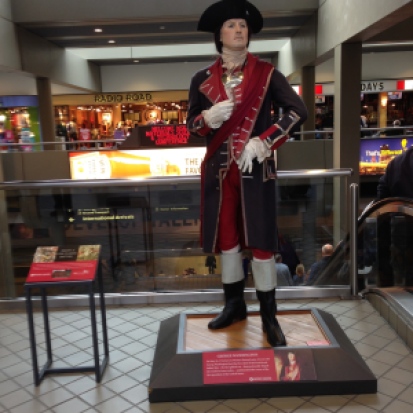
When we arrived in Pittsburgh, disembarked our plane and walked into the terminal an auspicious greeter waited. Just as I am about to head down the escalator to baggage claim I spot him: Franco O’Harris a Steeler famous for his Immaculate Reception! Steerlers galore, but and here’s the interesting thing, George Washington stood next to him. Two famous historical characters from venues miles apart, though George Washington is a bit more famous. Outside of Pittsburgh, of course.
 

IMG_5166


IMG_5167


Pittsburgh is brimming with history; its citizens are proud of the relationship with our first president, and sports, (Pirates, Penguins and Steelers) does reign supreme as one of the greeters indicated, but there is far more to this most friendly of all cities.

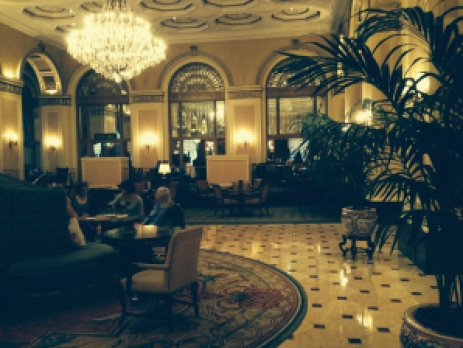
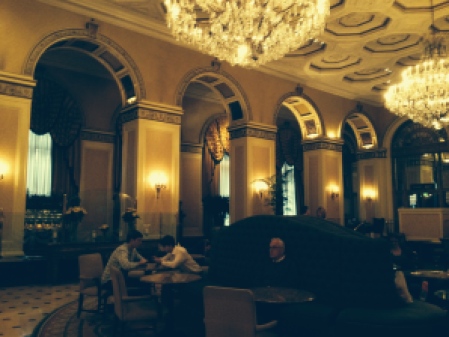
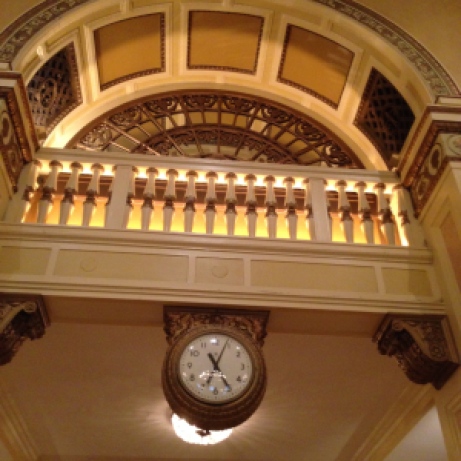
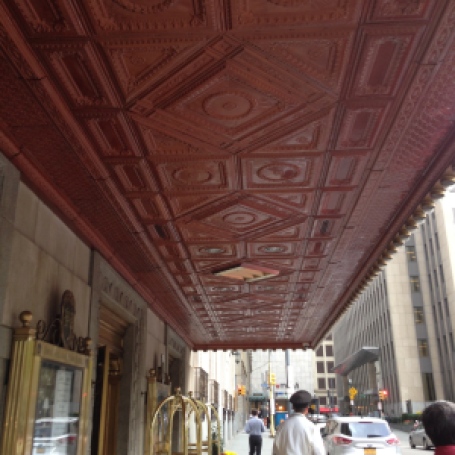
At the moment I am sitting in the William Penn Hotel in downtown Pittsburgh surrounded by the opulent design of a former time. There is no way I want to wallow in opulence, yet the Penn provides me with the comfort I need in this moment. A dated, but finely appointed lobby with comfy chairs, oversized sofas, bordered by restaurants, a bar, and a workout room, I am home for the next few days.

 

IMG_5174


IMG_5178


IMG_5176


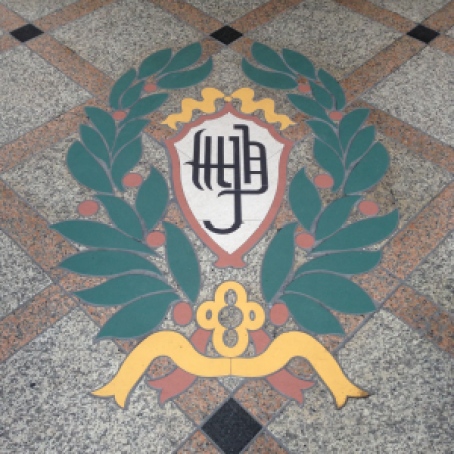
My gratitude goes to Henry Clay Frick the industrialist who ran up a six million dollar tab in 1916 to build the hotel. He intended to bring a hotel to Pittsburgh that would rival the great, grand, old world style hotels in Europe. To this day, the Penn remains what Frick envisioned: a grand old hotel.
 

IMG_5372


IMG_5371


IMG_5369


The pilgrimage to the steel city is truly a trip down memory lane. My life on this planet began on Pittsburgh’s North side in St John’s Hospital. The Sisters of Divine Providence were there, an omen for my future, assisting my mother with her long, laborious labor. I learned only today that the hospital was torn down ten years ago for, of course, a development.

Born and bred here for my first seven years established such a deep connection I will forever remain Penelope from Pittsburgh, PA. Today, while strolling around the city, I felt a root running from the soles of my feet deep into the terra below. The city felt inherently familiar and familial. As I walked its streets, bridges, hills, caught the aromas of the rivers, and heard words like babushka, you-ins, washroom rather than restroom some of the local lingo, old memories lurking in the recesses began to come forward and the bond I have with the city reawakened.

I came to Pittsburgh to accompany my partner to a conference. As soon as the plane landed, the ghosts of the ancestors began to shadow me, filling my thoughts and pulling on my emotions. Last night they haunted my dreams as I slumbered. I have no family left, I am alone in a familiar land, but the old hotel like visiting Grandma’s house offers solace, a protective place to come in out of the rain and nurse recollections.

When it opened the Pittsburgh Gazette described the Penn as “A house of a thousand guest rooms, without the need of candles, which after months of tireless energy, the employment of every known art and craft, the calling service of every ingenuity of man, is now a fact for Pittsburgh, and as such, is not only a magnificent illustration of the enterprise of Pittsburgh men, but its opening is an epoch in the history of this city as a community, …” How wonderful that even the building of the furniture was farmed out to local craftsmen.

To this day, the Palm Court lobby with walnut pillars, green Italian marble floors, a resplendent ceiling reputedly copied from the French Palace at Fontainebleau remains luxurious and lavish. The one per cent who formerly lollygagged in the lobby, feasted in the dining rooms still adorned with frescoed walls, hand-cut chandeliers and vaulted ceilings, danced their nights away in the ballrooms. Later, in the forties my parents would come to dance to the music of Lawrence Welk. To this day the large ballroom is named in his honor. As I walk past I hear echoes of his champagne music.


IMG_0122


When it opened, hotel guests were offered the latest amenities including: iced drinking water on tap, “certified” lighting, electric clocks, a telephone in every room and a private bathroom. The latter was offered at a time when many Americans were still using outhouses. (Add Internet, television, shower, refrigerator and room service for my current amenities.) The initial rate per night started at $2.50 for a standard room and escalated to $50.00 for a seven-room suite. I am paying a lot more. Thankfully it is under the cover of a business expense.

As we taxied in (Uber is not allowed to pick up at the airport), Liberty, Penn, Forbes, Fifth, Sixth, Seventh Aves – the names of streets that formed the grid I walked as a child called up images of taking a bus with my mother from the borough in which we lived to downtown. Frequently, we made on our way to Kaufmann’s Department Store where my grandmother worked at altering men’s suits, designing wedding dresses and making my clothes on the side. Edward Kaufmann, the President of Kaufman’s, commissioned Frank Lloyd Wright to build Falling Water leaving a legacy far more famous than my grandmother’s design skills.

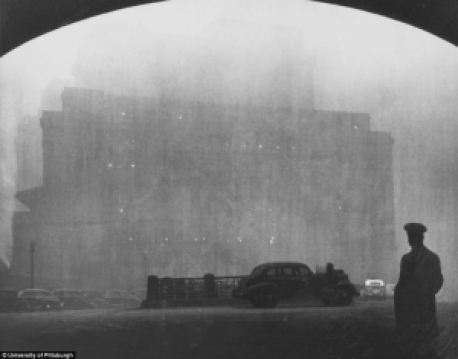
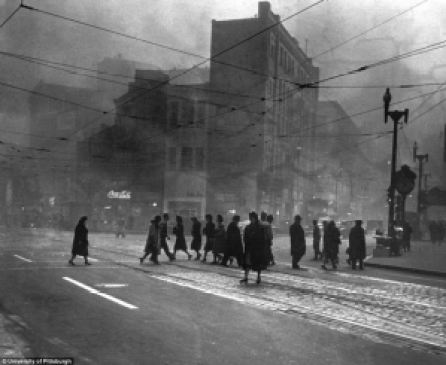
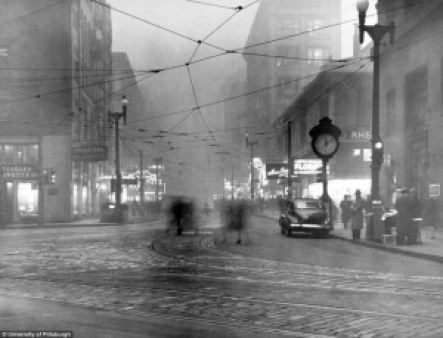
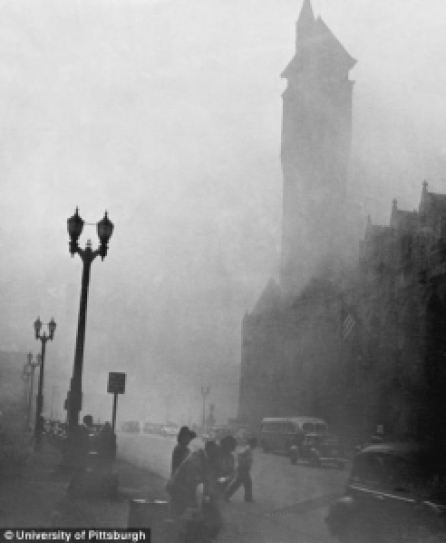
I remember downtown Pittsburgh when hang-over from the raspy spewing breath of coal mines and steel mills was so thick some days we could hardly identify the sun. And in the dead of winter, skies rained so much soot the snow cover turned black.
 

article-2155742-137C2577000005DC-317_964x737


article-2155742-137C2557000005DC-441_470x573


article-2155742-137C2547000005DC-671_964x756


article-2155742-137C2541000005DC-327_470x581


article-2155742-137C256C000005DC-413_964x788


article-2155742-137C252C000005DC-889_964x769


I recall leaving the city seated in the back seat of my dad’s old forty-nine Chevy to drive north to Butler County where the crystal blue, elegant skies that covered my great grandparents’ farm offered welcome relief.

The farm had been in the family since deeded to my several times removed, great grandfather, General William Critchlow for his service in the Battle of Saratoga during the Revolutionary War. Drives through violet pocked shimmering chartreuse-carpeted hills in summer, snow and ice flows in winter, imprinted scenes of the rolling hills of Pennsylvania permanently into my cerebellum. Inexorably, our journeys concluded on a pebbly dirt road angling up to the farmhouse through Grandpa’s sheep pasture to one side, buckwheat crops to the other. Buckwheat pancakes. Wish I had Great Grandma Chatham’s recipe.

Years later after we had moved to California Grandma Ethel May informed me that the farm had been deeded to the Boy Scouts when my great grandparents passed. Considering how the farm came into the family, that the Boy Scouts got it seemed to hold a certain logic.

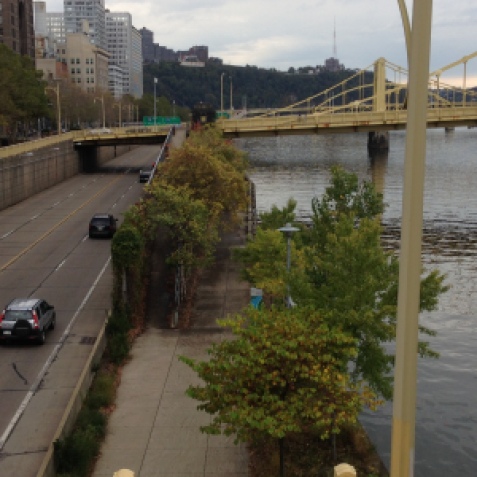
On arriving in Pittsburgh today one would never suspect there had been a time when it rated as one of the worst, smog-full, polluted cities in the country. As I poked my way around earlier today the skies bode clean and clear. Not only skies, but streets as well.


IMG_5325


IMG_5324


IMG_5323


IMG_5327


IMG_5326


In eighty-five ethnic neighborhoods old traditions maintained with differences among groups respected, continue to this day. As children we were told that we did not cross over to their territory uninvited, or “they” to ours. There was nothing wrong with any of us we were told, it’s just that “we are different” and should stay among our own. Lines were not only black and white. A mixed marriage – momentous – engendered discussions among the elders about whether the wedding ceremony should take place in the Polish, Irish, Italian, German, or Slovenian Catholic Church? As they were all Catholic I wondered how the Irish Church differed from the Italian? When I questioned them, the elders chided me with, “that’s just the way it is.” I said little in response, but and argument about ethnicity and race indued between my elders and my inner voice.

As demographics are changing, I suspect that the beautiful mosaic of ethnic groups with each piece loving its own, is changing as well. Community and tribes gather and form for reasons other than ethnic lineage.

Before leaving California, I researched the Pittsburgh food scene. The meat, mashed potatoes, corn, beef and cabbage, kielbasa, pierogies and salt water taffy of my youth would not serve my aged body. I searched every food site from eater.com to Yelp to the Pittsburgh Chooses sites and made up a short list of the eateries that appeared most frequently in the top five. I consulted with the locals. I wanted to eat the food of a progressive chef who is not afraid to move into new and tantalizing places with eye  fixed on vegetables. Paul the concierge at The Penn was confident that Grit and Grace would meet my requirements. “It was the only Pittsburgh restaurant to make opentable.com 100 best in the US list.” When I found out that its Chef, Brian Pekarcik from Murrysville, Pa had spent time at Gary Danko and Fifth Floor in San Francisco I was sold.

Walking over to Grit and Grace from the Penn earlier this evening, I missed the flocks of pigeons I chased off the street as a child. Nowhere to be seen.  When we arrived we decided to sit at the bar where conversations can be lively and informational. It’s is a great place to get to know people in the industry and with Pittsburgh being one of the friendliest cities in America, it called.

As I pored over the menu, the same menu I had checked out on line earlier, the lady next to me introduced herself, illustrating the friendliness I anticipated. Told me she lived in the southern part of the neighboring state, West Virginia. Had come up to attend a Jackson Brown concert with her daughter. She went on about how much she loved Jackson and let us know that if we were interested it was still not too late to get tickets to Fleetwood Mac who would be performing the next night. Always pays off to sit at the bar!

Grit means the texture of sand or stone used in grinding, and courage, resolve, strength of character. Grace, the simple elegance or refinement of movement, free and unmerited favor of God. Definitions of both words printed at the top of the menu inform the diner about intention.

“grace

/ grit /noun

/ grās /noun

1. simple elegance or refinement of movement.

2. free and unmerited favor of God.

It is said that everything needs an opposite in order to exist… to achieve balance.

“Grit & Grace pushes opposites to the extreme to bring you the most unique and balanced dining experience Pittsburgh has to offer.”

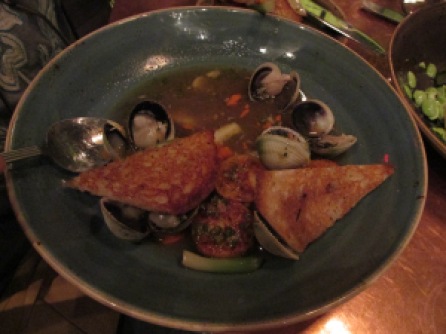
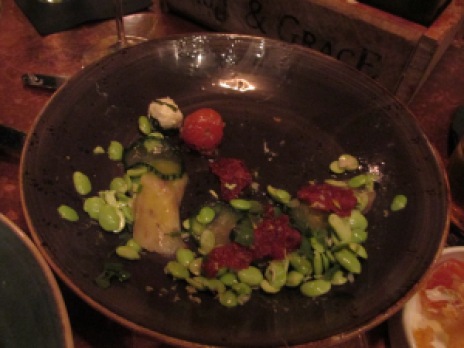
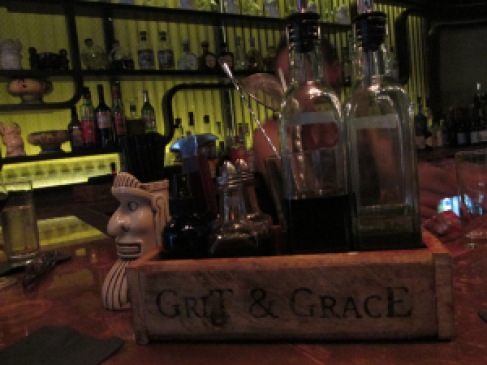
Chef knows his dictionary; I wondered if the conceptual would carry over into the food.  Pekarcik makes choices that represent “the diversity and sophistication of today’s diners.” Goat and curry, ramen, short ribs and biscuits, kimchi are but a few examples. He carries his choices through in the three daily condiments as well: soy and black vinegar sauce, chili sauce and fennel-onion compote. G&G specializes in small plates and American Dim Sum.
 

IMG_0123


Dim sum is offered in small bowls.


IMG_0127


Crispy tofu


IMG_0125


To be honest, I did not expect to find such quality, creativity and artistic ability of the chef an a restaurant in the city on the rivers. How I wish that Grit and Grace were around my own neighborhood corner!

More on Pittsburgh to follow.

October 10, 2014 Reflections on Bean Paste

To supplement or not to supplement with white bean paste?

Recently, I received an email from an old friend. No personal message, just a link to a weight loss product Forskolin, made from white beans. It included a video of Dr. Oz promoting the product. White bean paste sounded like a winner especially with  Oprah on a sidebar giving it a thumbs up. According to the info I received, white bean paste can help a girl to get rid of excess belly fat. The hidden persuaders tempting, I went online to purchase a round.

Just as I was about to click on the add-to-your-cart button a pop-up of my father appeared in my mind’s eye. When I was a child, he was fond of asking me if I lived to eat or ate to live? I thought of his question as his humorous way of making me conscious of how much food I was consuming. I never gave him an answer; I knew he didn’t expect one, but as he sat there in my mind’s eye, smiling no less, I finally responded. One cannot be separated from the other; the act of eating is both necessary to life as well as part of why we live.

Several decades back, I began to reflect on the kind of vehicle with which I had been blessed to carry me through this lifetime. I noticed early on that in spite of my mother’s well rounded healthy cooking my body gained weight rather easily. By the time I was in high school I frequently went on grapefruit and hardboiled egg diets so popular at the time, to help maintain my girlish figure. I had friends with the opposite issue; they drank lots of milkshakes.

After high school graduation I joined a western monastic community where we were served three squares a day prepared by professional chefs. Between meals, we had coffee breaks peppered with pastries and cookies. A year after joining my knees began to bother me. Our horarium included several daily rounds of prayers – knees to kneeler! When I approached my director about my knee issue, she told me I was overweight and suggested a diet. So, while my fellow classmates ate the fabulous dinners prepared by the chefs, I hightailed it over to a special dietary kitchen to pick up my perfectly balanced, oil and butter free, low carb diet. And coffee breaks became just that: coffee breaks sans cookies! The diet worked and in a short time, as I took off ten pounds, the knees went pain-free! Goal accomplished, I returned to a normal diet but minus desserts. However, my fat loving body had its own plans and the weight slowly inched up. How I longed for grapefruit and eggs.

I had a slew of relatives with adipose tissue issues, far worse than mine. As I observed their plump bodies I knew the genes had it in for me as well. From high school on through the years in the monastery, and long after leaving it I returned time after time to a “diet.” Not binge, but just to what helped to prevent bulge. Not only was I prompted by vanity, but also the desire to be healthy. I rotated through low carb, no fat, juice, all veggie, two annual ten-day water fasts and Weight Watchers. They worked. I cleared the toxins, slimmed down, but after awhile I would have to return to a more rigid disciplined way of eating.

On another note and while living in India in the nineties, I was introduced to the 5000-year-old Ayurveda health system. In what has been called the oldest holistic health system in the world. I learned about the three body types and the appropriate diet for each type or dosha as they are called. Kapha, pitta and vata refer to the elements earth, fire and water. Each body, it is said has a predominance of one or two and is called accordingly.

Wouldn’t you know it? I am heavy on kapha-earth with just enough pitta-fire to keep the fat under control. It is recommended that kaphas abstain from wheat and dairy.

After I returned from India the blood type diet became the rage. According to its guidelines, Type O’s such as myself should avoid dairy and wheat! It was beginning to sound like a conspiracy!

From a yoga regimen in India I went on to Tai Chi and became interested in traditional Chinese medicine (TCM) where herbals instead of chemicals are used to overcome negative body conditions as well as to cleanse and energize. In general, nine body types are described; we have physiological, structural, and psychological elements that create our unique bodies. TCM looks at the person’s constitution for clinical treatment, to promote health and to balance the yin-yang in one’s body. Once again, I found myself confronting foods that I should avoid or in this case, add to my diet.

As I made my way through the various traditions and paths of eating, not to mention my interest in farm to fork and Slow Food, fortunately, I began to listen to my body. At one point it told me to stop eating meat. I did, not for any moral or spiritual reason, but only because my body said, “don’t eat meat.” I agreed. In recent years it said, “don’t eat wheat.” OK, I said. Every time it speaks I find its message generally in alignment with the information I had garnered from my studies. I think that’s what’s called body wisdom.

I have learned that I need to make food choices according to my genetics, doshas, blood type, common sense and perhaps most important, body wisdom. How I carry them out depends on whether the body and spirit are willing.

We eat to live, but what we eat has an impact on how we live. We also live to eat but how we live is determined by what we eat. In its Greek origin, the word diet means a way of life. According to the above mentioned ancient health systems, the intake of food is advised according to the body type. If one follows what is suggested and listens to the body as well, diet does become a way of life.

In my growing age I finally reached a point where I had everything with my diet nicely settled. And then I receive the email about bean paste. Here’s the upshot. An active ingredient in white kidney bean extract, phaseolus vulgaris blocks the enzyme necessary for starch digestion. Theoretically, the starch will pass through the digestive tract without being broken down into simple sugars and later stored as fat. At last, with this miracle supplement I can eat pizza, pasta, bread, in a nutshell. all the carbs I want.

Tell me, what’s a girl to do?

October 3, 2014 Madonna della Bruna


IMG_5256


As we traveled through Sardinia, Matera and Bologna last summer, I discovered a country rich with on-going annual festivals many of which date back thousands of years. Some have become major tourist attractions as with the Mamuthones mentioned in an earlier post.

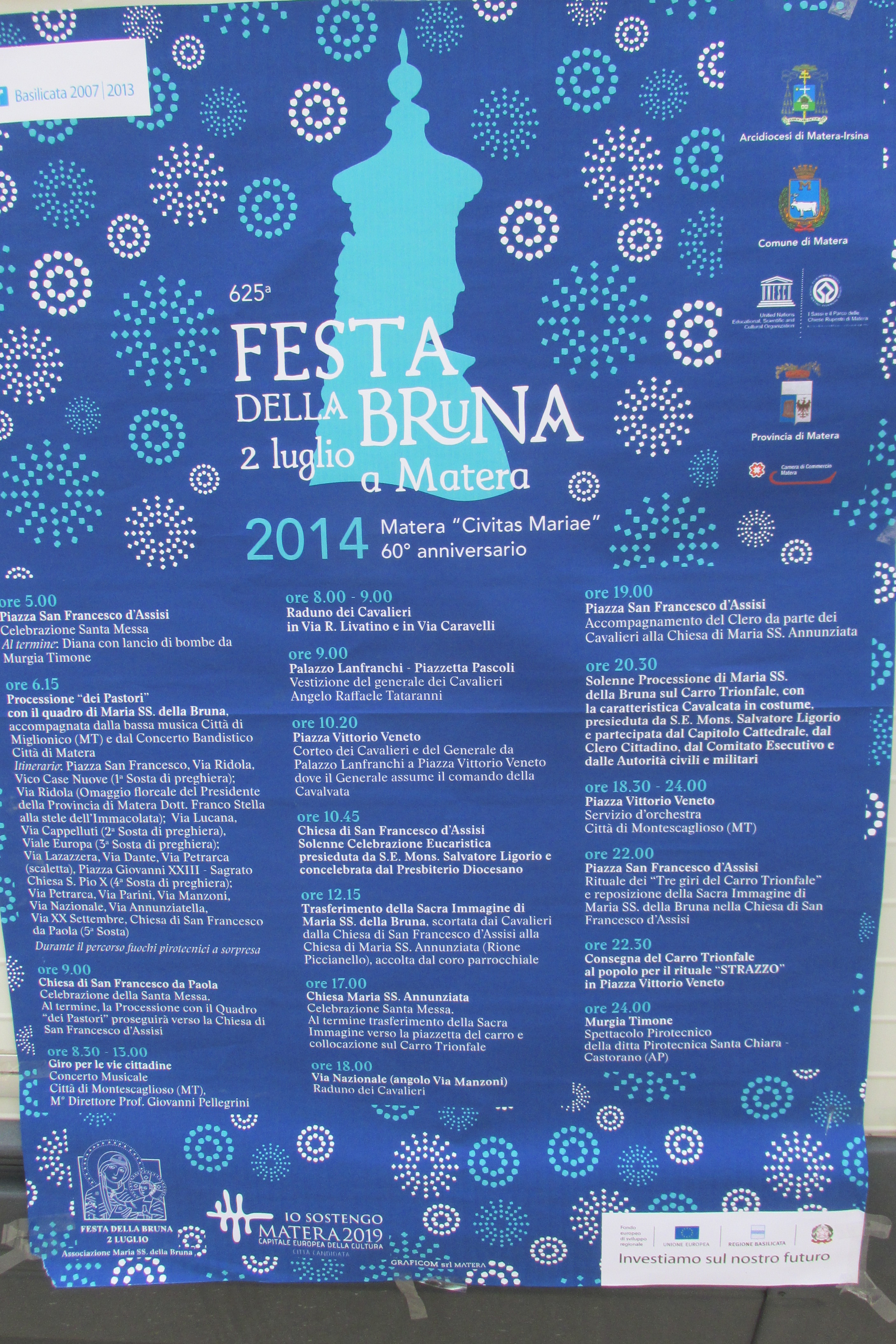
When we stayed in Matera in July we had the opportunity to witness the annual three-day festival celebrated in honor of the Madonna della Bruna. Historical and legendary accounts give an interesting background for the festival.

The legend recounts that in a time long past, a peasant woman agreed to escort a mysterious woman to Matera. When the carriage bearing the woman arrived in Matera the woman had disappeared, leaving a statue and a letter to the local bishop in her place. The letter claimed that she was the Virgin Mary. The bishop honored the letter and had the statue carried around the Piazza del Duomo (duomo is the Italian word for cathedral) three times. She became the protector of Matera. Today the statue is carried around three times in the same way on the evening of the third day of the festival.

The historical account says that in 1389 Pope Urban IV determined that the annual date for the celebration of the festival the Madonna della Bruna would be July 2. An interesting history preceded the Pope’s call. July 2 from the tenth century on became the day for the celebration of the Visitation the name given to the story recounted in the Gospel of Luke. Mary, pregnant with Jesus does a charitable act and goes to see her cousin Elizabeth, pregnant with John the Baptist. Just what two women friends, let along cousins would do if simultaneously pregnant! Urban also elevated the Visitation date to give it a place on the Roman liturgical calendar about the same time he established the date for the celebration of the Madonna della Bruna. Matera had celebrated the Visitation on July 2, long before Urban formally appointed the Madonna her role.

Prior to the celebration we know that antequated rituals to honor the earth mother goddess long celebrated through out Italy were assimilated from the fifth century on into Christian expressions. That the stories and legends surrounding them are/were real or delusional seems less important than their mythical significance.

So, whether rite of earth mother, celebration of the Visitation or  arrival of the legendary woman in a carriage, I was not prepared for the magnitude of the current day event. The shock of being knocked out of sleep by a loud cannon at 6:00 am on the first day of a tridium led me to my computer as well as to locals for a history lesson.

Marked with celebrations and festivities going on all over Matera the tridium caps on the evening of July 2. That night we witnessed colorful, loud spectacle with a secret float central to an ethereal performance that ended in an explosion of fireworks the likes of which I have never seen. (Fireworks From Matera can be viewed in an earlier post.)

The upper part of town, above the old sassis is where most of the events took place. In the week previous, elaborate decorations are constructed around and in the streets leading to the Piazza. Before the first day my partner and I took this all in, not because we were trying to, but because we happened on it as we strolled through the area looking for a place to eat, checking out shops and scouring the museums. We also encountered women from Africa doing exotic hairstyles along open-street salons and a giant street market that catered to the event.


IMG_5253


IMG_5254


IMG_5252


IMG_4282


Chalk street drawings are part of the rituals.


IMG_4283


On the third morning, the Madonna statue was taken from the cathedral, put into the float and transported to another church away from the piazza. We witnessed an afternoon filled with revelry, concerts, followed by an evening meal, and as dark descended the beginning of the culmination.

In the evening invited to the home of some friends of Tim and Chris we ate buffet style-a little like Italian take-out, but made by the attendees. As travelers passing through my partner and I sans personal kitchen, took wine as our contribution to the meal. Surprised, our gracious hostess assured us that our gesture was appreciated, but not necessary.

After the meal we climbed up the stairs of the five story house to the rooftop that overlooked the Piazza, the place where the tour of the Madonna’s float and ritual would conclude. We had the equivalent of box seats for the spectacle. The friends and relatives of the hosts gathered at the balcony edge in full view. Since it was our first time, our host pushed us up front so that we would not miss anything.


IMG_5508


For more than an hour we observed the scene on the plaza from the rooftop.


IMG_5478


IMG_5498


IMG_5493


IMG_5490


IMG_5507


IMG_5505


IMG_5502


IMG_5523


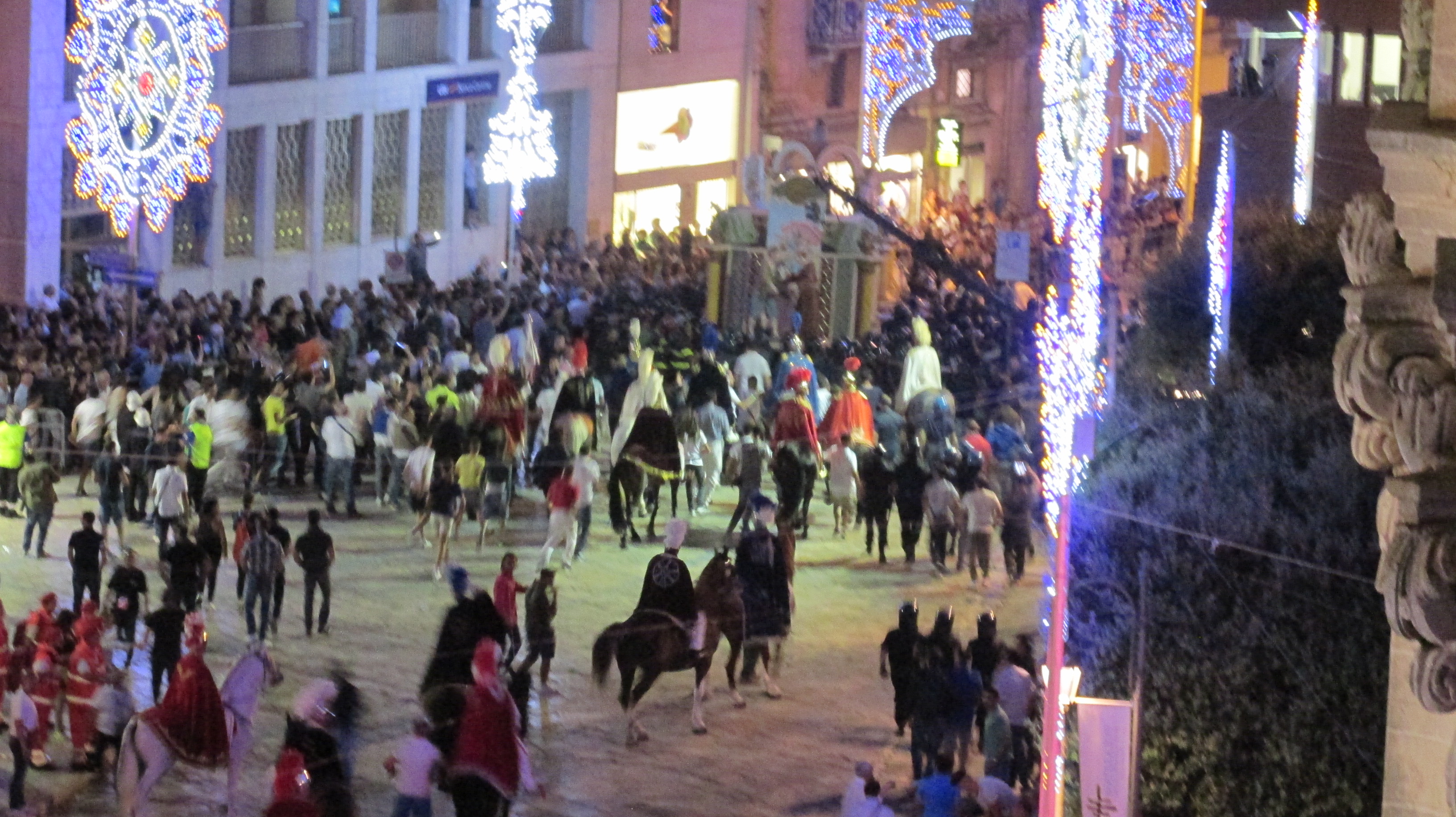
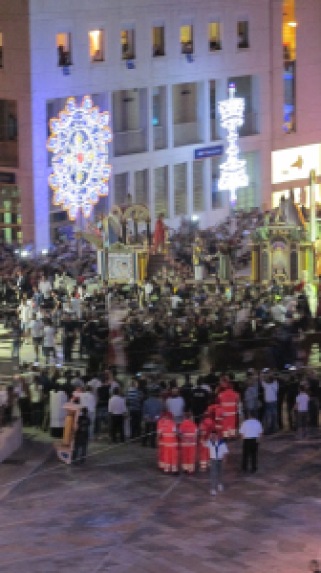
Finally, the paper mache float pulled by donkeys and carrying the Madonna  appeared.  As she reached the plaza populated to the max with locals and tourists, a full troop of uniformed knights of Santa Maria della Bruna riding tall, flower bedecked stallions, a parade of Roman clerics from the Archbishop’s court dressed in full religious regalia, and a band accompanied her float.


IMG_5541


IMG_5515


IMG_5516


The float made the customary three rounds. Following, the Madonna was taken out of the float and carried back to the church from which she had been taken earlier.


IMG_5530


IMG_5529


IMG_5536


IMG_5537


Then something strange happened. The US is not the only country that is witness to the militarization of its local police. A swath of carabinieri, dressed in military gear surrounded the float to escort it to the edge of the Piazza where the people as is the annual custom would destroy it. For this police oversight is called in. It is believed that if one obtains a piece of the float it will give protection for the following year. As the scramble for the pieces was about to begin the slow roving scene moved a little out of our purview.

But all was not lost! We climbed back down the stairs to watch the conclusion on local television.


IMG_5542


IMG_5543


The screen showed a crowd turned mob. It reminded me of beer bloated fans screaming and yelling while watching the Super Bowl.

As I witnessed the spectacle I wondered if in earlier years the energetic aggressive forms of destruction that occurred at the peak of the celebration were present then as now. The police tried to maintain the revelers at bay until the float reached its destination. Several men taunted police and vied with one another to be the first to get on the float. A scuffle ensued. I had been told earlier that this was not a place to be as it became rough and ready, and injuries occur. On the small television screen I witnessed sacred go profane! A reveler broke through the barrier followed by several others and began to tear the float apart. The Madonna had been honored, the aggressors had conquered. At that moment my fellow spectators cheered


IMG_5545


IMG_5547


IMG_5546


IMG_5552


The annual ritual concluded, we thanked our guests and made our way back to the hotel. As we desscended down the steps through the sassis into the old part of Matera many people moved along with us. I wrongly assumed that they were returning home. When we reached the hotel, we prepared for bed and retired for the night. With shutter and window open a plethora of stars quivering across the night sky illuminated our room. Street lamps flickered on the plaza next to the hotel. Silent darkness filled the ravine. All quiet, we nodded off to the goddess of sleep.

Thirty minutes later, from the deep of sleep, I was roused from bed. BOOM! Shocked, I dragged myself over to the window and peered out. Fireworks. In my groggy state I thought the fourth had arrived a day early. The dark ravine had turned into a cauldron of light and color. The locals that accompanied us on the walk back to the hotel stood along the cliffs above the ravine watching the kaleidoscopic sky pummeled with rounds of fireworks for forty-five minutes. Until 1:30 am my partner and I took turns sitting on the windowsill watching the conclusion to the festival of the Madonna della Bruna


IMG_5569