Travels with Penelope

Travel, Food, Wine, Spirituality and Everything Else

Author: admin (page 8 of 14)

May 22, 2015 Kyrgyzstan


map-kyrgyzstan-360x270-cb1316027942


After a return from the trip to Azerbaijan (See Land of Fire) last month it took but moments for the body to readjust and land on solid ground, the mind a bit longer. As images of fez headed Azeris and natural fires gradually receded, the smell of oil haunted my olfactory sense, while resident flecks of dust twirled in by winds from the desert continue to tickle my throat. Memories of the trip lingered like a long finish on a good orange wine, but even a good finish dissipates, and as impressions fell into oblivion the inner traveler began to grow restless. A trip to Poland had been under consideration, but surprisingly, “she” wanted to return to Central Asia.


As I pored over a map of Central Asia, for the first time I wondered why “stan” suffixed the name of seven countries. With Google’s help I found its meaning. “…The suffix “stan” is an ancient Persian and/or Farsi word meaning country, nation, land, or place of…”

Turkmen means “I am a Turk,” but interestingly, in the land of Turks many are from other countries. Uzbek: a “genuine man.” Uzbekistan, the nation of genuine men is a mix of nomadic tribes, Russians and ancient Iranians. Tajik: a person wearing a crown on his head also a mix of ethnic groups. In old Turkic Kyrg means forty. Later the language referred to “Land of Mountaineers. I found a fascinating history of its etymology on Wiki.

I would have continued into the histories, piecing the meanings together, but when I checked out Kyrgyzstan, a plan began to take hold. The thought of a country dominated by mountains and lakes had a faire appel. After the natural gas burning outlets in Azerbaijan I could welcome the energy of the Tian Shan and Pamir ranges of Kyrgyzstan. The thought of Tian Shan with Victory Peak towering over 24,000 feet, referred to as celestial, heavenly, god’s mountains made my heart soar.

After four plus decades of world travel I may read a novelist, but rarely do more than a Google or two on my intended destinations. I have learned that I will get what I’m supposed to know, meet with whom I am supposed to meet when I arrive. In the case of Kyrgyzstan however, my knowledge bank so meager, I decided to visit a bookstore. The store was stocked with a plethora of guides, but aside from a thick Lonely Planet devoted to cities around the world each with a couple photos, “stans” included, no guidebooks available. Amazon not much better, it was becoming obvious that Central Asia is relatively unexplored. Back to Google.

The history of the Kyrgyz people held many surprises: Old Tang dynasty texts described them as having “red hair and green eyes, (from Siberia) while those with dark eyes were said to be descendants of a Chinese general.” Other sources claimed that the “Kyrgyz tribes were described as fair-skinned, green- or blue-eyed and red-haired people with a mixture of European and Mongol features. At the beginning of a foray into a complex history, I wondered what the contemporary Kyrgyz would look like.

One evening after a session of deep academic study I turned off the computer, laid my head on the pillow of my Relax the Back Chair and closed my eyes. Long past midnight a hushed quiet had settled over the trees and field outside my study window. Astral hyper-looping unlike other modes of travel does not depend on ticketing or plane schedules, but rather on the intention of the traveler. As I unwound from my day the travel engines began to churn. I turned inward toward the vacuous space in front of my mind’s eye, which yogis refer to it as the door to the infinite. Mystical sounds like that of evening song birds began to emanate from the void. I felt a slight lurch.

Opening my eyes I was standing on the edge of a vast endorheic lake. A light balmy breeze teased my hair, soothed my body. My feet were comfortable in spite of the pebble-filled grainy sand under my soles. I edged forward a few feet and gingerly touched the water with my big toe. I knew that hot springs fed into this lake, but with endless layers of the snow covered high peaks of the Tian Shan Mountains framing the distant skyline I expected icy. I cupped my hand, gathered a bit of water and lifted it to my lips. Warm and slightly salty like the Caspian Sea, I thanked the guardians of the lake for their offering. I knew that pollution is a concern, but the lake is well known for its minerals and healing ability.


images-7


I marveled as I stood on the shores of the second largest alpine lake in the world (Lake Titicaca, the largest), Lake Issy-Kul.. Were it not for the snow-capped mountains, a border of tiered ridges, the blue sky and sky blue lake would have merged. Soft waves barely more than ripples, caressed my feet. I felt a oneness, a union of soul tied by a magical umbilical cord to essence.

I do not know how long I stood there soaking up the healing waters, but eventually I came to a sense of presence with the present. Curious, I turned my back to the water. A hundred or so feet away red tulips carpeted the borders of a narrow pot-holed road.


images-2


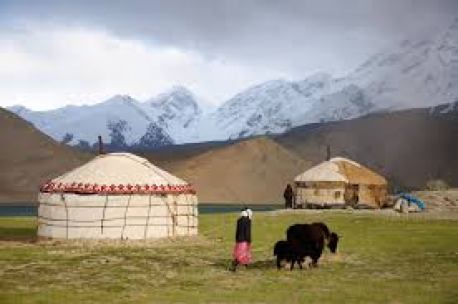
The road led through guesthouses and yurts the felt colored dwellings used for centuries by nomads, along the  shore. I had read that the village of Kyzyl-Tuu just south of where I stood, is primarily made up of yurt makers.

 

kyrgyzstan


images


A sound of a motor plowed the waters of the lake. I turned around to see a lone fisherman pulling in. He docked nearby and disembarked carrying a large black rubber bag filled with his catch. He smiled and surprised me with a hello in English. I expected Russian as I had read it might be the main language spoken around some parts of the lake. After introducing himself, Rustam told me that as a young man he had lived in England. He shared that his son Hamid owned the nearby yurt resort; he pointed to a camp of yurts, and invited me to come by for some lunch. I had read that the people were friendly, but this was far more than I anticipated.

As we walked I told him that my time was limited, that I wanted to go to Osh the oldest city in the country. I wanted to see the silk bazaar leftover from the days of the Silk Road trade. He told me that after lunch he would be taking a few horses to a nearby village to a tour guide. He would give me a ride and from the village I could hop a minibus to Osh.

When we got to the yurt camp I followed Rustam who ushered me into his home where he introduced me to his wife. She greeted me in a language I had never heard. It turned out that Rustam is the only family member to speak English. He told me that he had been a dentish in Osh. When he retired he and his wife Mierim moved out to the yurt resort to help their son. Mierim cooked local food for the guests, but on that day they had gone on a daylong horse trek so the three of us shared the meal.

Mierim as warm and friendly as Rustam offered me a bowl-like cup of what I thought was milk. Mildly flavored it tasted somewhat sour with a bit of tang, I assumed from alcohol. Rustam noticed my quizzical look. He explained that kumis a fermented form of mare’s milk is the national drink like beer or wine in other countries. “It is very important,” he added. “Bishkek the capital of our country is named for the paddle that is used to churn the mare’s milk much like in making butter.” The drink went down all too quickly and I knew I could handle it if it were offered again.

Our lunch was sumptuous. Mierim placed a cast iron pot of plov (chicken, carrots and rice) on the table, a plate of horse sausages, flat noodles and a naan-like bread with which we scooped up our food. I had heard that vegetarians can have a hard go of it in Central Asia, but under the circumstances the meal was a gift and I figured it best not to offend my hosts. The horse sausage reminded me of a gourmet tempeh, but more meaty.

After the meal, as Rustam prepared the animals, his wife refilled my cup. We tried to talk a bit, I was picking up on a few of her words and she knew a little English, but as I have found with many women around the world, when we don’t know one another’s language, we fall into heart talk. Before I left she went into her bedroom and returned with a small Russian orthodox cross and put it in my hand. We hugged. I had tears in my eyes as we parted.

I walked away waving to Merium. Rustam stood near the door holding the reins to two camels, I had expected horses.

To be continued…

May 6, 2015 Jiu

When I was introduced to orange wine I was drawn to its unusual gold color and out-on-the-farm nose. Earthiness describes my first taste. A lingering complex finish left an impression of a drink that had come from antiquity. Smitten in that first encounter, I imbibed a bit too much. The following morning in conversation with my son I revealed that the orange had loosened my tongue and as a result I waxed eloquent on expository profound truths or, to put it mildly, the gospel according to P.

My wise son had only one comment. “Mom, wine is the truth serum.”  My mind had a history of playing push-pull with to imbibe or not to imbibe. The idea of a truth serum deepened my quandary.

I appreciated the enjoyment a glass of vino provides especially when properly paired with food. Its health benefits are easily available through Google. Humankind has been enjoying the pleasures and benefits of the grape for at least 7000 if not a million years. The drunken monkey hypothesis has added to our knowledge of why. None-the-less and not infrequently, a nagging voice would chastise me with such thoughts as, “an enlightened being would not imbibe alcohol even if it were a low nine per cent Riesling.”

At times I wondered if my feelings were a hangover from a past life as a Hindu. On my first trip to India in 1985 it was nearly impossible to get an alcoholic drink outside a major hotel. Of course all of that has changed since and India has developed a thriving wine region. Or, perhaps I had been a Muslim. But then some of the first wines were produced in northern Iran. In hyper-looping around Azerbaijan an Islamic culture, I was surprised to learn that it has been producing wine for centuries. So much for past life theory.

On return from Eurasia, I decided to attend a conference on Understanding Jui: The History and Culture of Alcoholic Beverages in China. As wine production began in China, I anticipated getting a great deal of useful information that would help me in countering the inner nag. The Confucius Institute at UCDavis hosted the event in the Mondavi Food and Wine Center.

Before going further I need to report that UCDavis has just been recognized for the third year in a row as having the number one agricultural school in the world, and it’s the only UC campus to be number one in anything worldwide.

The daylong included talks and a panel by prestigious experts, mainly from China. Just what I wanted. Patrick McGovern drew me to the meeting. The Scientific Director of the Bimolecular Archaeology, Project for Cuisine, Fermented Beverages and Health at the University of Pennsylvania Museum and adjunct Professor of Anthropology at University of Pennsylvania, he has been most helpful to my partner and me on a book we are writing on the vessels mainly glass, used in making and imbibing wine.

McGovern’s research has been key to our knowledge of the use of alcoholic beverage in the ancient world. With a dual hat, he has pursued archaeological and chemical clues from ancient China and other parts of Asia to make his discoveries.

Fondly known as the “Indiana of Jones of Ancient Ales, Wines, cuisines and beverages,” his book In The Search for the Origins of Viniculture and Uncorking the Past: The Quest for Wine, Beer and Other Alcoholic Beverages reveals the story of humankind’s intoxicating quest for the perfect drink in ancient China is a must for anyone working in the wine industry. He describes how the analysis of early pottery from Hiahu in the Yellow River valley of China reconstructed a mixed fermented beverage of rice, hawthorn fruit, grape and honey. Analysis of bronze vessels from the Shang/Western Zhou Dynasty discovered that residue in the vessels still held liquids with millet, rice wine and beer from 3000 years back.

My nag listened intently to McGovern along with the several others who discussed how the story of alcohol has been foundational in every aspect of culture, not only in China, but others as well. Michele Yeh, the Department Chair of East Asian Languages and Culture at UCDavis for example, related that, in China by the third century, jiu became associated with poets so much so that, if someone claimed to be a poet but did not drink jiu, others questioned whether they could truly call themselves poets.

In China we find a history of formalized consumption as exemplified in state rituals, in ancestry worship, and in the rise of cult drinking in the third century when the meaning of drinking evolved. Social, political and intellectual factors contributed to the development of the rituals. Appropriate imbibing based on Confucian ideals also holds true. Drinking is not just about fallen down drunken stupidity.

Not only is the history of alcohol use in America short-lived in contrast to China, it has been frowned upon. One need only consider Prohibition as an example. Nor does it have the kind of formalized ritual around the use of jiu that is found in China. Wedding and New Years Eve toasts are two exceptions; the use of wine at Mass in the Catholic Church another.

If McGovern was the perfect keynote, Cecilia Chiang former owner of The Mandarin in San Francisco was the perfect close. Cecilia opened her talk on a personal note: “I am ninety five years old.” She described her life in China as the daughter of a wealthy, French champagne drinking family who fled during the Communist revolutions and moved to San Francisco in 1960. Opening a restaurant she offered many Northern Chinese dishes for the first time. Among other chefs she taught Alice Waters how to prepare excellent Chinese food. She spoke of introducing Mondavi fume blanc at her restaurant. She spoke of how Robert Mondavi with a bevy of wine knowledgeable guests often frequented her restaurant. With her inspiring talk,  my inner nag begin to wither on the vine.

On an entirely separate venture from the above, I had gone to Colorado to attend a retreat to be given by an esteemed Tibetan monk. The day before the retreat a friend and I were crawling down a dirt road exploring the local environs. When we passed a monk walking along my intuition stopped the car and inquired, “Are you giving a retreat?” After his affirmative answered we spent a several moments engaging in a delightful conversation. WhenI ran into him again that evening while registering for the retreat we resumed our conversation. I felt the beginnings of a budding friendship.

Following our karmic meeting, I drove to the only restaurant in the small town where I ordered a glass of cabernet to pair with a mushroom entre. While sipping and waiting for mushrooms the monk showed up. He passed my table and smiled. Chagrined, I felt like I had been caught engaging in crime, minor of course. Had I seen him enter, I would have hidden my glass. So much for budding friendship!

Moments later the he gave me a teaching. A server glided across the restaurant with a glass of wine and presented it to the monk. He turned and raised his glass in my direction.

Further chagrined, but, I breathed a sigh of relief to know that even some enlightened beings imbibe.

I’ve had enough of the nag. I’m giving him up. In his ignorance, he simply does not know what he’s talking about!


April 27, 2015 Land of Black Sand

After I returned from Azerbaijan, I could not get Baku out of my mind. As scenes from a long significant dream can fill the morning after with story from the depths of the unconscious, so too, scenes from the trip filled the early days of my return. Streaming colors, sounds, aromas, especially those from the ubiquitous presence of oil, and images of nature-born fires haunted my thoughts. Over the return week I sat in my garden assimilating the experience while gradually getting my land legs back.

Again as in the recent retreat I turned to literature.

To prepare myself for travel to a new place, I have made a habit of reading its well-known authors. Ines of My Soul by Isabel Allende helped to prepare me for a trip to Chili in 2007. Set in the sixteenth century, the story takes place at the beginnings of the Spanish conquest of the Americas. Allende spent four years researching and documenting the history of the founders of Santiago. Against that backdrop the personal trials and tribulations of Ines are recounted along with her challenges with the indigenous Chileans. Bloodshed and violence not withheld. Although Ines’ story took place four centuries before my first trip to Santiago, her history remains embedded in the ancient stones of the city and by the time I arrived in the capitol I had the same imprinted in my bones.

Orphan Pamuk in Memories of the City and My Name is Red prepared me for my first trip to Turkey, Haruki Murakami in several novels for Tokyo, Rabindranath Tagore for India, Jorge Luis Borges for Argentina, Paulo Coelho for Brazil, Octavio Paz for Mexico, Homer and Herodotus for Greece and most of my high school and university literature classes for Ireland and England.

The trip to Baku was so sudden and unexpected that I had no time for such luxury. In hindsight, I turned to Amazon and ordered a copy of what is considered a literary masterpiece.

Ali and Nino recognized as the national novel of Azerbaijan is set in Baku. The author writing in 1918 describes an endearing romance between a Muslim Azerbaijani boy and a Christian Georgian girl. Now there’s a tale to recount. My first thought on hearing the theme of the tale was whether Ali and Nino had to run for their lives to escape a negative response to their relationship. Instead the author portrayed Baku’s tolerant culture. Ali’s father, a noble Muslim, accepts his son’s choice. As it turns out, the major issue with Ali and Nino’s long relationship come when Ali’s friend kidnaps Nino. Eventually, long story short, the two are reunited. When the Bolsheviks recapture Baku, the couple flee to Tehran only to return later. Finally, when the Red Army pulls into Azerbaijan, Ali joins the defense forces and Nino flees to Georgia with their child. Sadly, Ali dies in battle.

I’ve hardly given a nutshell of the complex story, but at least the quick summary will serve to jog my memory in the future. I’ve discovered that astral hyper-looping causes me to become a bit spacy and until I retrieve my land-legs, it can impede my memories ability to recall historical facts.

I also returned to Paul Theroux’ journey as recounted in Ghost Train to the Eastern Star. From Baku, he flew across the Caspian Sea to Turkmenistan, site of the fourth largest natural gas reserves in the world, and landed in Ashgabat the capitol.


Turkmenistan-map


Turkmenistan has been at the crossroads of civilization for hundreds of years yet Theroux’ account of the dictator Sarparmyrat Niyazov and how he ruled the country would turn most westerners off to the possibility of following Mr. Theroux into that part of the world. After his sudden death in 2006, the Turkmens elected Gurbanguly Berdimuhamedow (the only one running in the election) as president. He overturned many of Niyazov’s policies and, not that life has become democratic, but many moves were made to correct repressive rules and regulations.

GB’s photo with the Obamas. From the color of the president’s hair, the photo was obviously taken several years back.


800px-Gurbanguly_Berdimuhammedov_with_Obamas-1


I was surprised to learn that Turkmenistan is the least explored country in Central Asia, but in recent years one site, a natural gas field, appropriately named Door to Hell has whetted the curiosity of tourists.


Darvasa_gas_crater_panorama


Another visited site in this land of mainly black sand desert is Turkmenbasy Ruhy Mosque the largest in Central Asia.


Ashgabat_(3891760823)


My week ended at a birthday party in Sacramento with a group of wonderful people from Poland. Over bowls of creamy Borscht, we enjoyed conversation and personal story. A few of the group read my blog so Baku intruded briefly into our conversation, but when the hostess spread the table with risotto, potatoes, leek and apple salad and grilled lamb all prepared in traditional Polish style the conversation turned to Poland. My friends  waxed eloquent on the forests, mountains and rivers in the north of the country. They advised me that I should make a trip to the north then head for Krakow in the south.

Never been to Poland. I am hearing the call. Hm……


April 17, 2015 The Land of Fire


FullSizeRender-3 copy


The first page in three months.

Thank you to those who have inquired about my whereabouts and state. As for whereabouts, I have spent much of the past few months in my home-cave on retreat, and as for state, save for a few broken fibers in back of the left knee – the kind of minor injury that impairs mobility (I am reminded of David and Goliath), I am fine.

My retreat from the dialectic of smart phone, email, twitter, instagram, Facebook, along with the cacophony of twenty-four hour news gave way to the silence of unbounded space. In the interlude I took up some of the books that had been gathering dust on my bookshelf while waiting to be read. Settling into an oversized Relax the Back Chair I renewed my friendship with Paul Theroux through Ghost Train to the Eastern Star, Paul Bowles through a collection of travel writings and Robert Thurman (father of Uma) through a book on Tibetan Buddhism

In my silent, capacious space, a trip to a faraway unknown place was the last thing on my mind. Calm abiding, sky gazing, intermittent bouts of meditation were more to the point, but in reading Theroux’ account of his train ride through Eurasia my inner traveler awakened and in the twinkling of a magical moment I was catapulted to Baku.

As my lips gently beeped Ba followed by the soft, forward whistling owl-like ku, I grew mesmerized by the lullaby like quality of the word. I began to repeat the syllables over and over like a mantra. Initially, I had no intentions but to savor the beautiful sound. Still, a word has the power to call forth what it names and as a result of thought and action, Baku manifested.

In truth Baku is no magical being and surely not a mantra, far from it. Rather the wealthy, oil rich capitol of Azerbaijian, it sits in a cove on the coast of the Caspian Sea. The sound of Caspian captivated me almost as much as the sound Baku. It stirred mythical images of handsome swashbucklers joy riding over the sea in luxurious freighters. In the silence of unbounded space my imagination lost all restraint. The Caspian Sea, the largest saltwater body on earth along with Baku had garnered my attention.


mazerbai


Apart from readings of Russian history and literature (who has not read Dostoyevsky?) in my youth and a recent trip to Turkey, I have paid little attention to this part of the world. I have been aware of those times when one or another, Georgia and Kazakhstan included hit the news over political squabbles or issues concerning oil production, but mainly Eurasia remained wrapped in a cloak of mystery. Now, mystery and cloak began to dissolve.

In its present form Baku is a bit of Disneyland, the Middle Ages, the Middle East, and Soviet Modernism over-laid with exotic examples of twenty first century architecture.


IMG_7715-2


FullSizeRender-3


In approaching the city from the air the Flame Towers claim one’s attention. Positioned on a hill overlooking the amphitheater shape of the city, three flame-like licks, reminiscent of playful fire goddesses oversee the city. The design of the towers originating in ancient rituals of fire worship, their pragmatic purpose is residential, hotel and office space. The trinity defines the skyline as it speaks to the historic identity of the city.


FullSizeRender-2 copy 2


FullSizeRender-2 copy 6


As my astral vehicle hyper-looped toward Baku my excitement mounted. It was spring equinox the first day of an annual tridium of celebration known as Novruz Bayram (Farsi for new day). Mr. Theroux and I arrived on the same day although several years apart. It is to him that I credit my newfound fascination with Baku.

Hotels were booked. Indeed, it is necessary plan ahead in order to find lodging for this holiday, but in my case I had no worry. Why with my unique mode of travel I was hardly in need of a room.

In the book mentioned above Theroux explains that “militant Islam” is said to have ended in one-way or another the ancient rituals in countries in which they took hold. But, he says, “Novruz Bayram was proof that some of the old rituals persisted in spite of being heresies.” An ancient Zoroastrian celebration, it is one of the oldest holidays on earth. I would discover that the way the Azeri’s prepare Novruz Bayram is similar to the way Christians prepare for Easter: spring cleaning, new outfits, seeding the garden with flowers, decorated eggs, and raising their smiling faces to the new sun as it enlightens the diminishing dark clouds of winter.

As I approached old town I could hear the sounds of music and laughter. The celebration in full swing, flocks of tasseled musicians played for the crowds, men and women danced in the streets while children chased one another in circles. Here and there a mime or two. I wondered if they had wondered in from the west?

Hungry after my journey half way around the world I headed for a street vendor busy making shishlik over open coals. My inner vegetarian was happy that he barbecued tomatoes, aubergines and peppers in addition to the lamb and sturgeon although I have heard that the sturgeon out of the Caspian is the best! I pointed to a veggie shish and he in turn sprinkled it with sumac and put it on a plate. Spooning a bit of saffron infused pilaf on to the plate he turned both over to me big smile included. Then, on what appeared to be a second thought, he laid a thin crescent shaped kuba on my plate as well. I thanked him in English. He seemed to understand.

With my plate in hand I continued on up the cobblestone path through old town. I passed several restaurants sporting special holiday menus with most listing traditional Azeri food: classic mutton pie, noodles and potato cakes. Aroma from stacks of freshly baked teneri on a table outside a bakery filled the air.

I found a small deserted park with benches. I sat down and began to enjoy my meal. A few pigeon-like birds landed at my feet. Cocking their necks to and fro cautiously observing me I knew they were inauspiciously begging. I hesitated to feed them.

Down a side alley to my left I could see a lamb penned up in the entry to a small apartment. It’s bleating had a kind of forlorn quality, a sort of forced wailing that led me to assume that the poor lamb knew that its destiny to provide food for the family was about to be met.


FullSizeRender-3 copy 4


I was reminded of a friend back home who raises a cow every year for the same purpose. By raising it on her own back forty she is assured of having grass-fed, humanely raised and slaughtered beef. I concluded that raising one’s own meat in the heart of this million plus city must be acceptable.

I sat for a long time or so it seemed, taking in the bright sun, slowly savoring my food, listening to the music, and observing the people. I was a long from home, in a foreign place, I knew nary a word of Azeri, but I felt comfortable and content. After awhile an elderly woman came out of the bakery next to the park. After observing me she went back inside the bakery then reappeared with a piece of teneri. She came over and offered me the bread. It was still warm from the oven. She did not speak English, but we laughed, bowed, nodded toward one another, I rubbed my tummy, and did a thumb’s up. She followed with a goodbye wave then returned to the bakery.

Slowing chewing on my bread I returned to my reverie. I felt I could sit there all day observing the playful Azeri’s and soaking in the spring sun. They seemed such a warm people. A dozen or so stray cats paraded by, wavy tails high in the air. The lamb quieted down a bit, stopped bleating when his master brought him some food. I knew I had to get on. With my trip so unexpected, I had made almost no preparations. I would turn myself over to my inner guide.

I was vaguely aware that Baku had its share of World Heritage sites. Some of my friends back home would not understand if I bypassed the sites. I forced myself up from the bench and made my way out of the little park. I would hyper-loop to those sites, but first my sweet tooth calling I decided to search out the Bisque Café. I remembered an article I had read sometime back by Aida Mamudova the founder of the Yarat Contemporary Art Foundation. My interest was in the art, but she had written her article for a travel guide in which she claimed that the Bisque had the best ice cream in Baku. Good for people watching as well.

I managed to find the café. Without Google maps my old sense of intuitive direction seem to come back. A young Azeri woman greeted me with a smile, I found myself beginning to expect smiles, offered several tastes of ice cream. So-so in my estimation, but with her generosity I felt compelled to order a full cone. I had no other Azeri ice cream with which to compare, but if this were the best, I would wait until I got back to California for more.

Tall three scoop cone in hand, I resumed my walk toward the historic sites. I have to admit there are times when I am bored by the smells of antiquity I frequently encounter as I waddle through old museums and ancient sites. However, when I arrived at Shirvanshah’s Palace ensorcelled with its magnificent complex of structures including a mosque mausoleum, burial-vault and divan-khans, memories of a glorious past life rekindled. I paid little attention to the historical footnotes placed here and there. Instead, I soaked up the energy. Ancient, I let it play a bit with my mind and body.


FullSizeRender-2 copy 5


Not too long though as I had so little time and I needed to make some hard choices between visiting an abundance of history and art museums or the sacred sites. I had hoped to see Zaha Hadid’s new architectural structure as well. Having grown accustomed to long draughts of quiet in my home-cave, I began to feel weary of the crowds and noise. Fatigue played into my decision.

The mythologies and rituals we create in our search for meaning and understanding as they took form in the ancient spiritual traditions, whether those that developed into major world religions, or the more occult hidden, esoteric gems, have always called to me. I could see that with its abundance of mosques, churches and synagogues Baku had much to offer in this regard. With its apparent acceptance of religious plurality I felt it must be a tolerant place. I decided to look more into this when I returned home and had my Internet library at my fingertips. Finally, with a need for quiet I decided to head for Atesgah the place where Zoroastrians had worshiped for centuries.

Atesgah was approximately thirty kilometers away, but I managed to motivate my way to it. When I arrived signs signaled (I had to intuit here) that I was in the “land of sacred fires” for which Azerbaijan has been known for thousands of years. With gas and oil deposits continually erupting the early travelers called it the land of everlasting fire. The founder of Zoroastrianism used fire as a metaphor. He too must have witnessed the spontaneous flames rising from the natural gas outlets around the countryside.


FullSizeRender-3 copy 3


I found the history a bit complex and shrouded, but as much as I could decipher, Atesgah had a long history of fire worshippers even before Zoroastrians used it for worship. The present day temple goes back to the 19th century. While the natural gas ceased long ceased burning, artificial fires have been installed.

Zoroastrianism was barely covered in a course on traditions of the world when I prepared for my degree in Consciousness Studies. Perhaps I am ignorant with my superficial smattering of its rules and regulations, but I am impressed that good thoughts, words and deeds, and understanding the purifying nature of fire, both key to the tradition are so important. Simple. Do need look any further in our mundane application of spirituality?

I was a bit disappointed that the temple fires are artificial. Still, I made my offerings of sage and incense to the gods and goddesses of fire before I left. It seemed appropriate to include offerings to Kali as historically Zoroastrianism has made its way back and for to India. Before leaving I found another bench and sat a bit, taking it all in. I was a stranger in a strange land, but again I felt comfortable and at home.

Over my few hours of moving about Baku it became clear to me that as is true of so many global cities, signs of gentrification are ubiquitous. Renovation on the rise, the old is coming down. As I had moved about dust from the pillaging work of large hydraulic equipment hung heavy in the air. Cats ran freely through forsaken home sites waiting to be destroyed. I saw the elderly hobbling along insecurely through the same while the blue-jeaned, young confidently foraged forward laughing and joking with their comrades. Baku had changed, was changing right before my eyes but signs of history, magnificent structures, and culture remained. I sat there taking it all in. I realized that I had been stretched, my universe expanded. Grateful, I thanked unbounded space for what it opened to me.

My thoughts turned to return. The thing about a hyper-looped, astral trip is that coming back is as easy as going. A closing of the eyes, an intention, and ploof, one arrives at the intended destination. Outside of time and space I returned as quickly as I had gone.

A bit of important data: if you decide to visit Baku, the weather in July through Oct is warm. January through June dry, November wet. December-January, cold.

January 2015 Inner Travel

The Winter Festival with its full monsoon of celebration, gift and food has quietly receded to an echo distantly drumming in the deeper crevices of my mind and memory. Prior, there were so many well intentioned plans including cookie baking to sitting in hermetic solitude before the fireplace while a coffee-ground log slowly burned its way toward extinction. After, longer draughts of same while waiting for more cookies to bake their way into edible form in space. My gifts arrived in spades: family, friends, space, solitude and art making ( the cookie work) and now that it’s 2015, we have a new trail marker along the illusionary path that we call time.

Added horizontally, 2015 is an eight year, or, another way to look at it, a year created by two fours. It takes a four to make a square. It takes two squares to cap and shoe a cube. In the world of symbolic process squares ground. Ground what? Whatever, better yet, whoever needs grounding. And to ground means? To sit squarely and solidly as a cube that fully recognizes itself as a cube while geometry turns into poetry.

Stillness and fire are basic elements of transformation. Give time over to shake and shift. Perhaps this is the deeper meaning of New Year’s resolutions: let go of the meaningless, the unnecessary, the trappings, and dive into unbounded space.

Is space anything but unbounded? My space, your space surely have boundaries. Unbounded space: the ocean of bliss, the pool of the unknown, the universe of the unlimited, is the only god-dess I want to know. May knowledge of the unbounded expand in 2015.

December 15, 2014 The German Toy


IMG_6540


As I begin this post the rain goddess along with Father Christmas is responding to our chanting and drumming. We had four inches of rain in Davis in one day, not counting what came after dark. In forty years I have never seen so much accumulate in twenty four hours. Other areas such as up in the Sierra foothills, were blessed with eight. Lake Shasta climbed five inches. Perhaps the worst California drought in 1200 years is meeting its demise as the weatherman predicts that more rain is on its way.

I cannot remember how or when I became a devoted tree hugger. When my batteries need recharging I throw my arms around one of my favorite trees. Not only do trees energize me, they are great conduits through which I receive love from Mother Earth. Some of my best friends are trees. I find it no wonder that they have played a significant role in the lives of humans throughout history.

It’s that time of year when we focus on their importance. We beautify  them with ornaments and lights, and give them a special place in our home.


IMG_6557


The annual ritual with the Christmas tree derives from ever so many ancient customs. Pre-dating the tree is an old belief in the magical powers of evergreens. The Druids (the educated and sometimes religious Celtic Gauls among others) for example, held that the leaves of holly were signs that the sun would never desert them. In ancient Rome greens graced the houses for the festival of Saturn, the god of agriculture as protection against evil spirits.

While the evergreen fir tree has been used in pagan and Christian rituals for over a thousand years, no one quite knows for sure when it was first used as a Christmas tree. The first documented case was in the town square of Riga the capital of Latvia in 1510. A plaque commemorates the tree in eight languages as the first New Year tree.

Miracle Plays performed outside churches in medieval times may have had a relationship to the Christmas tree. December 24 was the feast of Adam and Eve in the Church calendar. Paradise trees representing the Garden of Eden were paraded around town before the play. About the same time the production of passion plays that presented the Cross-as the tree of life spread from Germany throughout Europe. When the plays died out the tradition of the tree continued in a wider context and the Christmas tree custom, as we know it began to take shape

In the late 1800’s my grandfather immigrated from England to America. He had quite a surprise on the first Christmas he spent with his in-laws. When he went to the Western Pennsylvania farm of his new bride’s parents for the holidays he was amazed to see that a tree played such a major role in the Christmas festivities. I am told that he referred to it as “the German toy”.


IMG_6509


In his homeland outside of court circles, the tree did not make much of an appearance until 1922, and then mainly in the homes of German merchants residing around Manchester. Charles Dickens wrote a glowing account of a Christmas tree he had seen for a magazine article he wrote in 1850. From then on his fellow British including my grandfather referred to the tree as the “German toy.”

“I have been looking on, this evening, at a merry company of children assembled round that pretty German toy, a Christmas tree. The tree was planted in the middle of a great round table, and towered high…It was brilliantly lighted by a multitude of little tapers…sparkled and glittered with bright objects. There were rosy-cheeked dolls hiding behind green leaves…real watches (with movable hands, at least, and an endless capacity of being wound up) dangling from innumerable twigs. French polished tables…and other articles of domestic furniture (wonderfully made of tin) perched among boughs…jolly, broad-faced little men…their heads took off, and showed them to be full of sugarplums; there were fiddles…trinkets for the elder girls…baskets and pin cushions…guns and swords…witches…to tell fortunes;…tee totems, humming tops, pen wipers, smelling bottles, conversation cards, bouquet holders, real fruit made artificially dazzling with gold leaf; imitation apples, pears, walnuts crammed with surprises; in short as a pretty child delightedly whispered to another pretty child, her bosom friend, “There was everything, and more.”

“…some of the diamond eyes admiring it” Dickens continues, “set me thinking how all the trees that grow and all the things that come into existence on the earth, have their wild adornments at that well remembered time.”


IMG_6541


While the practice of honoring and decorating trees traverses many traditions, it is through the German immigrants to Pennsylvania that the Christmas tree custom took root in America. By the time Grandpa arrived in America the Christmas tree having made faster progress than in England was well on it’s way to becoming the very core of the Christmas celebration, not only in Pennsylvania, but throughout the country as well. By 1900 one in five American families had a Christmas tree and by 1910 nearly all children had a tree at home. Only in small, isolated towns in the South and West were trees somewhat scarce until after 1915. But even then, community-hall or church trees were common.


IMG_6518


The lighting of the community Christmas trees in downtowns across the country follow a tradition first established in 1909 in Pasadena, California when a decorated a tree with outdoor lights was placed in the center of town. A community tree appeared in Madison Square Park in 1912 and in Philadelphia the next year with a tree in Independence Square. President Calvin Coolidge established the national tree-lighting ceremony in 1923.

Before my grandfather arrived on the scene my great grandparents had been quick to take on the custom of the Christmas tree from their German immigrant neighbors. Great-Grandpa staked out his tree in the late Fall while walnut-ting then chopped it down a few days before Christmas. My father who spent his childhood Christmases on the farm recounted that the tree set up in the middle of the parlor, was loaded with popcorn balls, candies, nuts and fruits-such as oranges from California, small toys and a dollar bill nestled in the boughs for each of the children.

If Dickens were observing Christmas 2014, he would note the same sparkling, diamond eyed children, young and old gathered round a tree likely set up in the great room where a vaulted ceiling can accommodate at least ten feet of height. Brilliantly lit with indoor lights, it is covered with an amazing array of ornaments from stores such as Target, and Macy’s. At its base are gifts many of which were still in the mind of the universe at the time Dickens described the German toy. Wrapped in colorful boxes we find computers, cell phones, television wrist watches, I-pads, gift certificates from Nordie’s or foodie restaurants, Legos, Coravins, and maybe a bike.

IMG_6551


As the little rosy-cheeked child remarked in Dickens’ experience, “There will be everything and more,” around the Christmas tree. So, tis the time, to turn our attention from torture, immigration issues, money scandals, polarizing politics and with the children turn our attention to fantasy, magic, wonder, to the other side of the human condition, and celebrate the winter festival.


IMG_6496


IMG_6494


IMG_6500


December 12, 2014 Sandy’s Chutney


Today for the first time,  I am turning my blog over to a friend. She sent me this note this morning and it is well worth reading. Not only is it a good chuckle, but talk about “food” for thought as we prepare food for the holidays! Some of you know her…she has a small farm just east of Sacramento, California.

Here is my Thanksgiving story that you might think worthy of a column, at my expense.

For this Thanksgiving dinner, twelve of us gathered at the wonderfully restored adobe home of great friends here in Sacramento. The owners, Laurie and Jacek, are outstanding architects who have created a magical miracle out of some old adobe bricks. They have a son Stefan, who is Zane’s age, and we have been friends now since the boys were toddlers. Both young men came to the Thanksgiving dinner in fine form.

Laurie and Jacek are serious foodies to boot, so the bar is high, but the rewards are great.

My assignment for the dinner was pear chutney and Humboldt Fog cheese, and Crostini.

I begged to be let off the hook, because my Sonoma farm partner foodies make a wonderful cranberry fig chutney that would surely work.

But Laurie would have none of it, and so I was left to fulfill my assignment with honor but no dignity, as I was without the required culinary skills.

For two weeks, I had scoured specialty stores throughout my California centric travels, looking for a pear chutney that I could take out of the jar, and put into mason jars to give off the appearance of home made. But that strategy proved fruitless.

So I then tried the bait and switch approach with a simpler recipe, but Laurie was clear about her sense of order would be awry without the prescribed pear chutney and Humboldt Fog Cheese.

So by last Monday, panic was beginning to set in, and now no time for ordering anything on line, I was resigned to having to actually gather all of the ingredients. So, the great scavenger hunt was on! But then I was immediately stumped by the call for pear cognac. Yikes. So I spent another day in search of pear cognac. Finally resigned myself to having to go to Corti Brothers, a famous specialty grocery store in Sacramento, with everything, including pear cognac. The recipe called for 1/4 cup. The bottle was $50, French of course. Then on to get a quarter wheel of Humboldt Fog cheese at $34 and the cheese paper that was a requisite for such wonderful cheese, if there should be any left over (there was, but not much). I did not have cinnamon sticks in my cupboard, so went off to my neighbors to find that all of his cinnamon sticks were in cardboard boxes with no expiration dates, but had to have been at least 30 years old. So the new cinnamon sticks were in class jars, set to last about 30 years, along with the bay leaves which are not grown in my garden, but clearly I need to plant, given the prices. Next were the oranges and lemons. There were two choices for the oranges, naval, or canna (which turned out to be a cross between an orange and a grapefruit. The grocery clerk and I taste tested the lot to pick out the best, and the canna won hands down. Next I was on to the shallots and unfortunately my shallots are still in the ground, growing away, albeit slowly now that ‘winter’ has set it. Finally, the recipe called for butter, and so topped off the day with some special hand churned butter from France. All in hopes that great ingredients will can make up for the errors and omissions of the cook.

My exit toll out of Corti Brothers stood tall at $135.

Of course, the pears came from the local organic farmers market, and cost $5.00.

Such are the wayward ways of your friends from California who have much to be thankful for and much bounty to celebrate with, but with more reckless abandon then sense. What would the pilgrims say to $140 pear chutney?


December 6, 2014 Mattress Factory


IMG_0449


Thanks for all the wonderful and mainly humorous responses to the last post on husbonda. With all the possibilities that were suggested Wolfman included (explanation offline), I shall continue to use partner when I am writing about travel with rather than solo.

In spite of the years I have spent in the art world as a student, a gallery owner, a curator and an arts writer who covered artists, galleries, museums, exhibitions and projects related to the creative process, until my trip last October to the steel city I was unfamiliar with the Mattress Factory. As I read about it in a top ten sites to visit, my inner voice prompted me to “Go!” Not one to argue with the intuitive, I obeyed.

The museum, a composite of nine inner city, mainly old homes that have been restored and adapted specifically for the purpose of exhibit and hands on work by the artists is located on Pittsburgh’s North Side a few blocks from the very spot where I was born.

Keep reading!

In its brochure the Mattress Factory defines itself as “a museum of contemporary art that exhibits room-sized works called installations. (installation is a genre in which site-specific works are created that are intended to alter the viewers’ conception of a space.) Created on site by artists from across the country and around the world, our unique exhibitions feature a variety of media that engage all of the senses.”

On entering the museum I almost ran into two three dimensional word balloons by multi dimensional artist John Pena. Pena provided a thought provoking opener that tailed me through my entire visit.


IMG_0451


IMG_0452


The seriousness of the word balloons followed by its polar opposite “Damn Everything but the Circus” by Ben Sota was pure play! To attend a circus  is one thing, but here I actually became part of a social circus!


IMG_0432


IMG_0434


IMG_0439


IMG_0445


Next, some images from Diaspora by Ryder Henry.


IMG_5500


IMG_5503

IMG_5502


More images follow, but first the Museum’s description of Ryder’’s work:

“Ryder Henry creates models of cities that replicate real places in his neighborhood (true to actual scale), combining fantasy sci-fi motifs like space ships and futuristic “Jetson-style” buildings with contemporary architecture. Henry’s preferred medium is recycled cardboard—often collecting boxes right off the street.

Outside the city are the brick towers that hold sentry across the suburban expanse. These buildings are the hubs of their own autonomies. What they lack in aesthetics, they make up for in utility. In the spaces between, the viewer may imagine farmlands and useful things, being looked after by the occupants of these structures.

Beyond the brick towers we see giant ringships in outer space. These are self-contained biospheres with variable gravity and other necessary space stuff.”


IMG_5511


IMG_5507


IMG_5516


IMG_5515


An exhibition that took me by surprise Traces of Memory by Chiharu Shiota, was an exemplary example of what Carl Jung must have meant when he said, “As a human being the artist may have many moods and a will and personal aims, but as an artist he is ‘man’ (woman, too, Carl) in a higher sense – he is ‘collective man’ – one who carries and shapes the unconscious, psychic life of mankind.”

As I walked through the site I became part and parcel of the installation – which is of course, the intention of the artist. With threaded mystery leading me, I found myself jockeying between timeworn rooms that led my consciousness as it were through a passage not unlike Alice’s rabbit hole into new dimensions.


IMG_0516


With fascination I tripped through the knotted and woven caves and hollows that dominated each room. Loose woven cords like spider webs, crisscrossing, interconnecting interiors sets, and rooms were knitted together with the expertise of a craftsperson, the eye of a designer, the soul of a creative spirit, The giant weavings held me in their grip as a willing prisoner.


IMG_0502


IMG_0504


Enclosed old furniture, tattered paper remnants leaving exposed walls brought to mind the history of former occupants. As I gawked and gaped my way through their former space their spirits silently hiding in the shadows stalked my every move. A stranger in their midst I had been granted access to the hallowed space in which they had lived out their soulful journeys on earth.


IMG_0503


IMG_0509


IMG_0514


IMG_0515


IMG_0513


I felt like an astronaut visiting an unknown planet, a historian observing antiques long forgotten and leftover from another age, a dreamer caught between the real world I had just left and the ephemeral that threatened to disappear in and at any moment. I became a child tantalized, but fearful of what lay just beyond each doorway. I would get lost in the anxiety of the unknown only to return as a wayfarer giddy in unbounded space.


IMG_0499


IMG_0507


IMG_0506


IMG_0508


Completing my crawl I turned and made my way back in the opposite direction seeing the same from hindsight – something we rarely do in real life.

Over the years I have worked my way through various definitions of the purpose of art. “To make the invisible visible,” “to make the daily meaningful,” “to express abundance,” “to arouse consciousness,” “to decorate,” are but a few. Art happens in a studio, on a wall, in a public site, but art creates in here where I think, breathe, feel, contemplate.

Shiota reminded me that art and life art are not separate. I have often pointed to the fact that in Balinese there is no word for art as art and life are one.  What happens in here is reflected in the work of  artists who have the talent to replicate in here  out there.  Whatever the former space, boarding house, apartment, stripped down abandoned home, Shiota took it by hand and deftly wove a history with warp and weft that took this viewer from the external into the mythic dimension. I went in; I went out, and arrived at the same place.

A regular performer on the symbolic stage earlier Shiota studied with Marina Abramovich and assisted Rebecca Horn. With her sensitivity to how our bodies move through space and its potential to get trapped, her installations lead one to experience the untouchable: unbounded space,

If Shiota’s weavings drew me into dark and intimate spaces, the windows in the set of rooms following her installation opened into yet another dimension where windows framed outdoor scenes of paintings that cannot be framed.


IMG_0580


IMG_0579


IMG_0584


IMG_0585


IMG_0583


November 26, 2014 Husbonda and Gratitude


IMG_0462

I want to acknowledge and respond to some comments that have come from my readers. Seems that the time of posting has caused a little confusion. As one person said, I was getting posts on Sardegna long after I thought you had returned to the States. Right! Frequently and for purposes of reflection some posts are written post trip.

Then, there is the partner issue. ”Why do you call him your partner?” This one has really bugged a few (I have noted that the few are of the upper generation). I thought it was perfectly appropriate given the evolution of relationships with their sundry varietals. I like a universal concept as in “partner,” it rules out types, discrimination and expectations. I have always looked on my significant other as my partner in my life. Both are found under definitions of the H word.

The Old English husbonda  defined as the master of a house is derived from the Old Norse husbondi. Hus meaning house and bondi householder. (Does that mean a wife is in bond to the master of the hus?) Bua also elated to Old Norse means to inhabit and is akin to Old English buan to dwell. Buan is related to bower for which one definition is a lady’s private apartment in a castle or medieval hall. Exploring husbonda does get complicated.

In my travels through several on-line dictionaries, husbonda is consistently defined as master of the house-note, not a partner in life, but one who lords it over. My partner is definitely not one who lords it over, so I wonder if he still qualifies as a husbonda? No matter, I will continue to refer to him as partner, thereby covering all bases: better half, companion, consort, mate, spouse, Mr. Right, soul mate among others.

In conclusion,  I will end with Happy Thanksgiving. May you and yours, partners, children, parents, and friends find joy in sharing this auspicious day. Be it far from the maddening world of commercials, sales and materialism, and aligned with human connection, meaning and gratitude for life. Tagore speaks of art as the expression that comes out of abundance. May this be a most artful day for all.

Penelope (and her partner)

IMG_0441


November 13, 2014 qahveh kaneh


In the once upon a time of typewriters and land phones we had a post-modern qahveh khaneh (Arabic for coffee house) in Davis replete with a counter and spinning, padded bar stools. The counter faced an open window through which those of us sitting on the stools observed the cooks preparing hash browns, ham or bacon, eggs and short stacks. Rise and shine came early in those days. I would bike down to Sambo’s, the chain started by Sam Bettistone in 1957, arrive by 7:00 am notebook in hand, and take my place at the counter. As the shop filled with patrons, coffee cups, spaced a padded stool apart, formed a line like toy soldiers down the counter. The waitress never asked if we wanted a refill; she simply replenished every cup as soon as it emptied. We regulars were grateful for the bottomless cup of Folgers or Maxwell House diner coffee.

The counter was a place where writers of all persuasions gathered. Some such as myself came to eke out stories, essays, or poetry, and some, academics from UC Davis came to edit future publications. Scattered among us were other locals just in for a quick cuppa Joe. After greeting one another and a friendly inquiry or two we would slump into our private space and thoughts. Against the clatter of heavy ceramic dishes set to counter and waitresses shouting orders from the four directions to the short order cooks, Sambo’s was anything but quiet. Inadvertently, in our articulated bar stool space we nudged each other, bumped elbows and whistled forgive me’s under our breath. In spite of the hub-bub, the counter offered what we needed. Writing is, I won’t say lonely, because I am not lonely when I am in that space, but it is a place where one journeys alone. Writers have no co-workers to chat with, no clients or customers; dialogue takes place between the writer and her inner voice; yes, they are two distinct voices; at our common table the counter, we worked separately, in solitude. We wanted that solitude, but we also wanted community. Both were to be had at the counter, and, at that small university-town Sambo’s, I had my intro to counter-culture.

By the late 70’s 1100, Sambo’s peppered the nation. (Due to a surfeit of law-suits because of its derogatory name, Sambo’s became The Jolly Tiger.) Denny’s came on the scene as well and like Sambo’s offered food and a counter. Dunkin Donuts limited itself to donuts and coffee. From the late fifties, coffee shops became an established part of the national culture.

On a visit to see my brother-in-law in Seattle in the seventies, he encouraged my partner and I to stop by a new coffee house located downtown not far from the first Nordi’s! It’s interior and menu reminded us of the coffee houses we had experienced in Europe. With the arrival of Starbucks, pre-brewed gave way to fresh brewed coffee, percolator pots to espresso and cappuccino machines. Following the Boston Tea Party in 1773 Americans turned to coffee as their preferred beverage. Two hundred years later Starbucks created a major shift in the American palate.

A few coffee houses were on the scene before Starbucks, mainly Italian in places like Little Italy in Manhattan. In the sixties and in their early careers, Joan Baez and Bob Dylan performed at coffee houses in The Village in NYC. Lightnin Hopkins in his ’69 song “Coffee House Blues” complained that his woman was failing to take care of the domestic front due to spending so much time at the coffee house. However, prior to the ‘90’s, coffee houses were mainly found near college campuses; coffee shops serving family meals proliferated everywhere. But, leave it to Starbucks to pave the nation with coffee houses and a radical menu.  Latte and cappuccino became household terms.

Starbucks, later Peet’s and Coffee Bean on the West coast were among those “houses” that paved the way for an emerging third wave: sleek coffee bars many with their own roasting equipment and staffed with talented and friendly baristas.

According to the National Coffee Association, in ancient times, “Coffee was not only drunk in homes but also in the many public coffee houses — called qahveh khaneh — which began to appear in cities across the Near East. The popularity of the coffee houses was unequaled and people frequented them for all kinds of social activity. Not only did they drink coffee and engage in conversation, but they also listened to music, watched performers, played chess and kept current on the news of the day.  In fact, they quickly became such an important center for the exchange of information that the coffee houses were often referred to as ‘Schools of the Wise.’” One story describes how Sufi monks discovered that drinking coffee helped them to stay awake during early morning prayers.

It is not known exactly when coffee migrated from Ethiopia to Yemen from which the first coffee houses spread throughout the Arabian Peninsula. In the fifteenth century, the first house opened in Istanbul and in 1530 a coffee house opened in Damascus. In the following two hundred years the development of coffee houses went from the near east to France, Holland and Brazil.

As with the wine of the grape, the wine of the bean has classes, varietals, is influenced by latitude and longitude, weather, and local soil; all providing an influence on aroma and taste. Lately, I’ve been drawn to coffee from Ethiopia, the oldest site for raising coffee beans on the face of the earth. In her beautifully illustrated book Coffee Story Ethiopia, Majka Burhardt describes its history where, to this day, it creates “a livelihood for a quarter of Ethiopia’s population and accounts for 60% of its foreign earnings.”

Having the good fortune to be near enough to Portola Coffee Lab in the OC, Intelligentsia, Blue Bottle and St. Frank in SF, and Stumptown in LA, to visit on a regular basis, my palate has been  educated and broadened. I look for the quality of taste that truly reflects the bean, no interventions please, and I want a cup made individually, not one from a dispenser with coffee that has been sitting on a burner. When I travel I search out the best qahveh khaneh I can find to enjoy the finest example of the qahhwat al-bun’ (wine of the bean).

On my recent trip to Pittsburgh dark roast, bitter, pre-brewed coffee, flowed abundantly. I had just about given up hope of finding a “decent” cup when in my comings and goings from the William Penn Hotel I noticed a large poster in the window of the former Alcoa building. Under bold-faced letters, SIMPATICO – an invite into the lobby for coffee. I was skeptical – good coffee in the lobby of the former Alcoa headquarters? But longing for something better than the chain coffee at the hotel, I decided to give it a try.

The small bar dwarfed by the enormous lobby did not dissuade me.


IMG_5481


IMG_0418


IMG_0371


When Ward, the owner, welcomed me and asked if I wanted “pour-over or trifecta,” I knew I had made the right decision. I perched on one of only two high-topped tables and eagerly awaited  my pour-over. This was neither shop nor house, nor did it have the sleek look of the new bars, just a bar. While I waited, several people in black business suits stopped for a cup to go. Ward delivered. I tasted my Americano and melted. After finishing my cup I approached Ward and we launched into conversation about the state of coffee in the steel city. He recounted  two events that lead to the founding of Simpatico.


IMG_0421


Ward had moved to Pittsburgh from Seattle to work for a start-up, but, when the start-up failed and with his background in Seattle’s coffee rich town, he decided to bring his knowledge to Pittsburgh. A second event happened when Alcoa moved to a new headquarters. With the old building impossible to sell in view of the economy, the executives of Alcoa turned the building over to the city to be used as a business space for non-profits. Ward envisioned a coffee bar in the lobby. When he approached the managers, they offered him the small area used by former security people to check out visitors to the building – a pittance of space in view of the new bars – still, a space to make coffee and one that is playing an important role in the development of fine coffee taste in the city.

Ward reads the state of the local palate honestly with an eye to improving it. Fresh roasted coffees from La Prima Espresso Company are offered from what Simpatico “believes to be by far the best roasted coffees in the region “…unlike many downtown coffee establishments, we truly care about our product: properly extracted espresso; properly steamed milk; and not everything made ‘to go’—we offer ceramic cups for you to stop, sit and relax, and thoroughly enjoy a true coffee break….We don’t consider ourselves coffee snobs – we even sell flavored coffee, in our own opinion, a belittling element to quality but definitely what many of our customers want.”

Currently, with one of two trifecta machines available in all of Pittsburgh, Ward plans to bring in others, the finest hi-tech equipment available. That he has been asked to do a second downtown Simpatico speaks well for the first. Perhaps Pittsburg a second tier city with a bad rap is beginning to prove the naysayers wrong.

Simpatico in its Latin derivation sympathia means sympathy. Sympathy: “a mental connection or bond with someone, in sync with as having a psychic link to someone, getting along with, having mutual understanding, agreeable, likely, similar convictions, drives, direction, same pathos-emotional feelings, sympathy with deep understanding and full response, shared attributes, interests, of like mind or temperament.” Herein may lie the reason that coffee houses have been part and parcel of daily life from the sixth century on.

Ward serves up the finest coffee in Pittsburgh and like its name Simpatico, the small bar in the enormous lobby serves as a place to gather and bond, the same role that coffee houses played in the Arabian peninsula from the sixth century. I am pleased that I decided to give it a try for two reasons. One, apart from the quality of this particularly well articulated wine of the bean, the local dearth of what I wanted in a cuppa joe led me on an expedition not only through my memories, but to the research stations as well. Not only did I become curious about the origins of coffee, I began to reflect on the need, not for the beverage itself, but about the fact that every country has a favorite beverage. As stated earlier, ours would have been tea were it not for the Boston Tea Party.

Older posts Newer posts