Travels with Penelope

Travel, Food, Wine, Spirituality and Everything Else

Author: admin (page 11 of 14)

6-16-2014 On to Rome

My partner called Uber at 6:00 AM. Within fifteen minutes Kushal picked us up. I knew it would be a safe ride to the airport the moment I saw Ganesh on his dashboard. With traffic on the 405 amazingly light for the early morning commute slot, we arrived at John Wayne Airport aptly named for the big guy, by 6:30. At barely ten years old I can remember seeing JW at the local Thrifty’s Drugs former home of the nickel ice cream, and probably the nearest drug store to his home on Lido Isle. Sightings of celebrities were common in those days with the coastline a preferred playground, and are still so today, but not only was John Wayne famous, the people of south OC loved him.

Kushal described how he worked his way around the world to get from Nepal to the US. As a driver for hire, he worked in Israel, Italy and Germany, the latter for a handicapped man, as he related it. All the while his intention was to work his way to the US. Now, finally settled in his home of choice California, he has started a family. To show his loyalty to his new home he gave his four-month old daughter an American name.

Kushal’s is one of many amazing stories, I have heard recounted by Uber drivers since we joined up last month. The ride to the airport cost us 25.00. The same for a taxi would have been 40.00 sans tip! No wonder taxi drivers are rising up against Uber! In some places Uber has wiped out fifty percent of taxi business.

On the flight to Chicago the man next to me all dressed up like a CEO in his crisp white shirt, perfectly creased, light coffee pants and spit shined oxfords read through reams of charts making notes here and there. I noticed Southern Wines and Spirits in bold print across the top of the pages. I would have struck up a conversation about the wines part, but noticed late in the flight and at that point I was not much in the mood for conversation.

A few minutes before landing he pulled out a new hardback—Collective Genuis. I could not help peering over his shoulder, checking out a few lines. I had the middle seat he had the window so I faked looking out the window when in fact I was checking out his book. What young executive geniuses are reading these days roused my curiosity. I picked up that the book’s purpose is to help top leaders in management deal with their role as group leaders. Leaders I read, should hold group meetings, try to get everyone to share ideas, encourage experimentation, enlarge on the collective genius of a group, and so on. It all reminded me of what my developmental psychology teacher imparted as I was preparing to go into teaching about forty years ago. Same lines, different times.

There is also a priest on the plane. It’s comforting to know that last rites are a possibility should something go awry.

The pilot provided a moment of shock and awe when he hit, rather dove into the runway. I cannot recall a landing so hard. When we disembarked and I smelled popcorn right out the gate, I knew we had hit Chicago.


photo-29


Cozy now on the flight to Rome, we are more than halfway. On an old American Airlines plane, so old it reminds me of the TWA plane I flew in on my first plane ride, a flight from LA to Pittsburgh back in the sixties. The meals skimpy, no snack in the kitchen, thank goodness they are coming out of bankruptcy.

Sorry I forgot to get some melatonin. Impossible to sleep.

June 16, 2014 Enroute to Italy


photo-27


My partner has been invited to speak at conferences or teach at universities in Italy for the past several years. We have rarely planned a trip for personal purposes. The call simply comes and we are off. Food, wine, culture, history and now Pope Francis to boot, Italy has become the gift that just keeps giving. Occasionally, I get smug,  think I have seen it all, then another trip comes up and we return to see a new piece of the boot-shaped land.

In a few days we will fly out with Sardenia, Basilicata and Emilia Romagna as destinations. This time, no speaking engagements, no conferences, instead we are travelers with no purpose other then exploring and enjoying what lies ahead.

In speaking to people about the trip I have been surprised by a question that has come up repeatedly: Where is Sardinia? It lies off the western coast of Italy a little south of Rome. The French island of Corsica rests a few miles north, but we will save it for a later trip. The map  gives a good view. Click it to see it.

Posts to follow.

June 4, 2014 The American Woman’s Cookbook

IMG_4052 1

A blanket of grey May covered the skies for a few days, but then the heavens opened, the sun reappeared and given perfect weather, I decided to head for the beach. With book underarm I jumped into the Prius, drove down the canyon to Laguna and settled on a warm patch of soft sand. A day so lucid the limestone colored rock cliffs on the south end of Catalina Island, stood clearly delineated against the horizon. Beyond: unbounded space.

 Relaxed in the comforting presence of negative ions I opened a book that had been gathering dust on my cookbook shelf for several years.

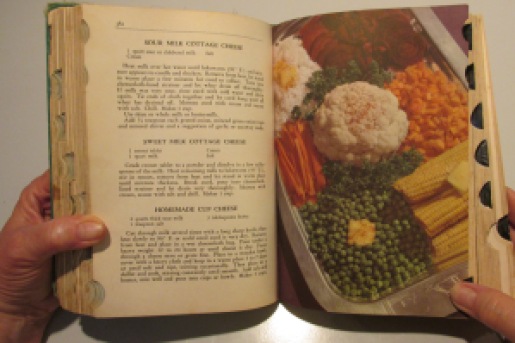
The American Woman’s Cookbook first published in 1938, seven years later than the first Joy of Cooking was my mother’s first cookbook. I held her 1942 edition in my hands, the one that most influenced the meals that made their way to our family dining table.

IMG_4084

IMG_4050 1

The introduction listed the Butterick Co. as the publisher with credit paid to The Carnation Company the producer of Irradiated Carnation Milk for being

 “among the first to present pictorially in full, natural color of many of the appealing dishes, which grace our dinner tables… The development of printing reproduction in full color of difficult food subjects is a fascinating story. The color pages in the book required not only skillful preparation of the dishes to be photographed, but also an advanced photographic technique which makes possible the brilliant colors and superb craftsmanship of modern photoengraving. The beautiful pages which have been included in this volume effectively vitalize the recipes and add inspiration to the occupation of cooking.”

IMG_4081

IMG_4075

IMG_4071

Cookbooks provide recipes, but they also give an account of the transformational process of American life. With The American Woman…I realized how cookbooks  reflect social concerns, national mores and cultural bias.  In 1942 for example, a woman’s occupation stated indirectly in the above, was definitely in the kitchen.

The opening pages offer sage advice.

“To become a good cook requires more than the blind following of a recipe. This is frequently illustrated when several women again note, “women” living in the same community, all using the same recipe, obtain widely differing results. It is the reason so many cooks say, ‘I had good luck with my cake to-day,’ or ‘I had bad luck with my bread yesterday.’ Happily, luck causes neither the success nor the failure of a product. To become a good cook means to gain knowledge of foods, and how they behave, and skill in manipulating them. The recipe by itself, helpful as it is, will not produce a good product; the human being using the recipe must interpret it and must have skill in handling the material it prescribes.”

Clearly, there is a distinction between good cooking and following a recipe. How often have I heard, “I can’t cook, but I can follow a recipe,” from the mouths of some of my close friends.

Useful facts about food anticipate the recipes.

Methods of cooking for example, are defined as: boiling, simmering, stewing, steam, pressure cooking, broiling, baking, poaching, roasting, sautéing, frying, braising, fricasseeing and fireless cooking! Methods of mixing food follow: stirring, beating, folding in, cutting in, creaming, kneading and larding. Temperature is important: cooking by exact temperature is recommended and therefore an oven thermometer is needed…

Extended information on several key ingredients is revealing. Starch is a headliner with points to be observed in cooking starch-rich foods, the thickening power of flour or cornstarch and methods of combining flour or cornstarch with liquids. The same is done for sugar, the use of fats, shortening, milk and eggs.

 Michele Obama would love the four pages that are devoted to school lunches.

“As much care is needed in selecting and preparing food for the child’s lunch at school as for the other meals served to the child. If the lunch is inadequate or lacking in food essential throughout the school year, the child’s whole nutrition will be seriously affected and “his”, parentheses are mine, work at school will suffer.”

It is recommended that the lunch “possess the following characteristics.” Abundance, regard for the nutritive needs of the child in relation to the whole day’s food, and be “clean, appetizing, wholesome and attractive”.

One menu suggestion among several:

                                    Cream of Spinach Soup (in vacuum container)

                                                             Crackers

                                      Raisin and Nut Bread and Butter Sandwiches

                                                            Apple Sauce

Perhaps this book is more hip than meets the eye. Since the first publication, have we evolved or regressed?

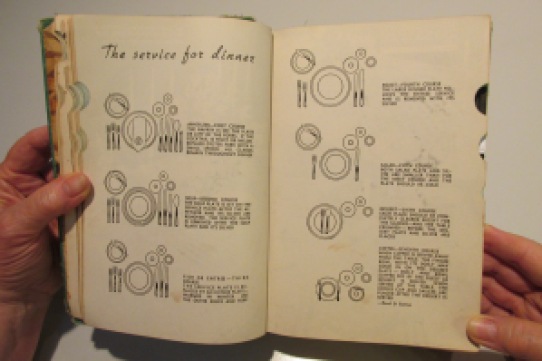
Need to know how to set a table? Check this out.

IMG_4068 1

The joy of perusing turned up recipes for grouse, opossum, reindeer, squirrel and venison. Intriguing.  I doubt that they will make their way into my kitchen, but some of the following just may.

IMG_4062 1

IMG_4072

IMG_4055

May 22, 2014 Verbena

There was no over-arching plan, it just happened as in “there are no accidents.”

In ten days my partner and I completed a spontaneous, edible crawl that left my mind windy with thoughts about what Peter Wells of the New York Times in a recent article on L’Arpege referred to as “the rising cult of the vegetable”.

We had planned to dine at L’Arpege last fall when we were in Paris, but with the restaurant booked on the only night we had available, our plan failed to materialize. In covering the rising prominence of veggies, Wells aptly describes what we missed.

“Dinner started with a plate of leafy radishes followed by a small cabbage turnoverand ended with a garlic crème brulee whose burned-sugar shell had been liberally spritzed with lemon confit. In between came a dozen courses made from turnips, carrots, peas, beets, cauliflower and potatoes. Two see-through bands of lardo on grilled white asparagus and, down at the bottom of vegetable minestrone, some bits of chorizo that would have fit into a gum wrapper were the only visible signs of animal flesh…

…Many chefs have been saying that their imaginations are no longer fired by pork chops and chicken wings, that the most exciting frontiers in cuisine are growing in the garden. Vegetables are both the medium and message…

…In the rising cult of the vegetable, L’Arpege is seen as an example, an inspiration and an early adopter.”

Cult?

A menu that focuses on vegetables may be unusual, however, vegetables are not offbeat, trendy, or just a fad. Rather than a cult, their rising is a movement. We surely saw signs of it in our recent experience at three Northern California restaurants: Gather, (Berkeley) Verbena (San Francisco) and Mother (Sacramento). After our first palate bending meal at Gather described in the last post was followed by a second similar experience, we decided to drive across the Oakland Bay Bridge to try Gather’s sequel, Verbena.

Chef Sean Baker, Esquire’s Chef of the Year – 2010 opened Verbena in the Russian Hill district of San Francisco in January. Soon after it made Eater.com’s Heat Map. And hot it is! With some friends we arrived on a Friday at the peak of dinner hour sans reservations. We put ourselves on the wait list then walked around the corner to Biondivino, Ceri Smith’s wine shop where we sipped prosecco while waiting. Shortly, the hostess called us to dine.

Accompanying us were Ceri, recently declared Food and Wine’s Sommelier of the Year, Clare Hasler Executive Director of the Food and Wine Institute at UC Davis, and her husband, Cameron. A brood of foodies to say the least!
 

photo-25


Verbena like Gather is not vegetarian, but with its plant-friendly menu, a full veggie or vegan meal excluding the tempeh burgers, rice and tofu or cheesy burritos that are often associated with vegetarian restaurants, is available.

Unusual ingredients are turning up on current menus. Among Verbena’s we spotted ovage, bottarga, nipetella, benne, oxalis on the menu. Curiosities aroused we ordered roasted button mushrooms accompanied by cauliflower, lovage and tomato vinegar. I have since learned that lovage follows capers and tea in quercetin so obviously, a healthy choice.
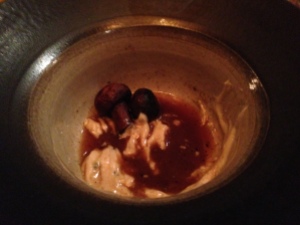


photo-26


Sprouted seed bread surrounded by a spread of chevre and beet sauerkraut followed. Heavy with seeds, the bread chewier than a German rye, spread with a swath of kraut-chevra created perfect marriage between sweet and sour.

Cardoons and rhubarb with caramelized honey dressing and Douglas Fir yogurt nepitella (an herb of the mint family frequently used in Italian cooking) offered a study in contrasts—of taste more than texture. Not big on rhubarb, the only food I generally pass over, I was not the best judge of the dish, however, my fellow diners raved about it.
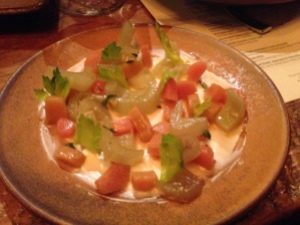
 

photo-30


We moved through the four nameless sections of the menu with each section increasing in intensity. Three plates included, charred carrots with smoked cashew, lemon verbena, Perrine lemon-date molasses, asparagus with mustard greens, egg yolk comfit, bottarga, green garlic, and beets and strawberries with black walnut-beet miso (Baker is said to have fifteen misos aging in the kitchen) ginger, cress and oxalis.
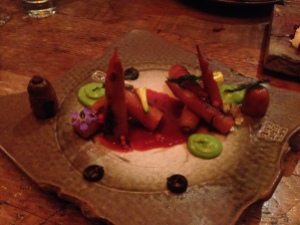
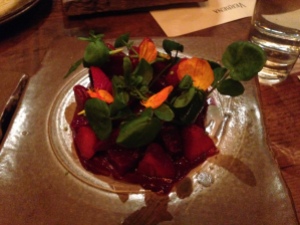


photo-27


photo-28


photo-29


Oxalis?

After ordering the beets I could not resist goggling oxalis on my I-phone. It is sorrel. I grow sorrel in my herb garden so I was more knowledgeable about its taste than I anticipated. Sorrel part of the knotweed family, as are rhubarb and buckwheat, is green and grassy with a lemony taste. For some it may take a bit of getting used to. I chop it up as an accompaniment to dressings, soups or toss the whole leaf in salads.

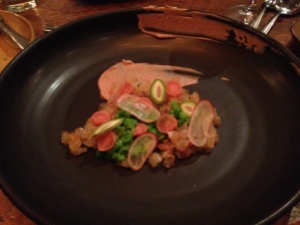
It turned out that every dish we ordered was composed of veggies with one exception. The King salmon tartar radish cured in lentil miso, with lemon and green almond slithered down gently, coating the palate with a taste that matched the touch.

Our dessert the pea tendril cake, came with a side of chamomile ice cream and rhubarb. Rhubarb again, but I have to admit this time I loved it!
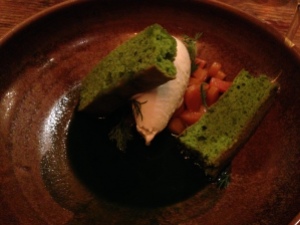


photo-31


Why Verbena? I knew it as an herb, but a name for a restaurant? Back to google, getting the following information I understood. Verbena: an annual or perennial herbaceous or semi woody flowering plant that has been used among others, in herbals, teas, folk medicine, as a protection against spells, a dream enhancer and through out history associated with divine forces. It’s that last part: “associated with divine forces” that explains the name for me. When food is cared for so carefully, treated respectfully, honored as a gift from the mother (Gaia) that it is, the chef sets the foundation for a divine experience. Sean Baker’s work lives up to the name: Verbena.

A few days after our first meal, we had to return to San Francisco for an event. Following the event we headed back to Verbena. We started with the little gem salad. Dressed in pumpkin seed milk Beluga lentils rained over snap peas and avocado. Small glistening Belugas gently cooked to just the right texture added a caviar like element to the salad. Now I understand how a Beluga lentil is supposed to taste.

My partner went on to smoked duck wings slathered in kumquat hot sauce, celery and benne seed or, as we lay people say, sesame. He described the wings as tender, melting and chewy with the nutty sesame adding depth to the kumquat.

I could not pass up the seared artichoke, asparagus and snap peas dressed in black garlic and sorrel-pickled green tomato vinaigrette. Back in 1996 in a fine restaurant in old town San Juan, Puerto Rico I had a mushroom soup that left an indelible mark on my memory. That soup will now have to share memory space with artichokes, et al.

I was so impressed and taken up with the transcendent quality of Sean Baker’s edible art, I forgot to take photos on the second round!

On a final note, the vegetable movement clearly evident in the above menus is taking hold not only in the restaurant industry but in other areas as well. Recently for example, 60 Minutes aired a study of 1400 active and healthy ninety-year olds, living in the world’s largest retirement community, Laguna Woods Village in Laguna Woods, California. The three main reasons given by the retirees for the good life are regular exercise, a preference for vegetables, and the use of wine rather than chemicals for medication.

(Unfortunately, Verbena closed, the owners hired a new chef and renamed it Reverb. The menu has changed significantly.)


May 2, 2014 Gather

The current trend: is it a plate of food or a work of art?

Recently, my partner and I headed to Berkeley for a talk to be given by one of the authors of Unbounded Wholeness, that book I have been traveling with since Vietnam. Although the talk was scheduled for 7:30, Tenzin Wangyal Rinpoche is famous for showing up early and I wanted to be seated by the time he walked in. We decided to have an early dinner at Gather a restaurant less than ten minutes away from where the talk would be given.

My vegetarian friends, Gather is not vegetarian, had spoken highly of its plant friendly menu. I crave vegetables; in fact they are my favorite food; I looked forward to a round of Gather. The place was booked solid, but we got seats at the bar where walk-ins are seated on a first come, first serve basis. I sat down to read that Gather serves biodynamic, organic or wines made with sustainable practices. So with that news, we were off to a good start.

Ordering could be tricky. I do not like to attend lectures on a full stomach, but with the availability of a vegan, gluten-free charcuterie, that proved not to be a problem. Current meal planning is not an easy matter for chefs especially in places like Berkeley where multi-forms of eating choices thrive. With diners having gone vegan, gf, pescatarian, macro-biotic in addition to omnivore, chefs are forced to ignore a growing part of the foodie population or simply adapt with a broad spectrum of friendly meals. In Gather’s case, the menu provides an umbrella that covers all needs

The charcuterie with its four chosen vegetables reminded me of a Byzantine mosaic  composed of  bits, chunks, and slices of turnips, beets, mushrooms, citrus and complemented with swaths of puree, and peppered with hints of various herbs, spices and nuts. If one yearns for simplicity, this is not a dish to order. It was a bit much for a friend who designs food sets for professional photo shoots. ““I want just carrots, simple, fresh and to the point,” she commented.

For others, myself included, the creamy and crunchy textures, the savory, spicy, smoky, fermented, citrusy, umami flavors deftly blended with the veggies and so articulately laid out, offer not just a lovely twenty first century combination plate but a piece that could be represented in an art exhibit. I think this is what is meant by the phrase “edible art”.

The eye-popping presentation presented a row of mushrooms slathered in a creamy, fermented carrot that just popped. Mandolin sliced radish and bits of chervil added a twinge of red and green coloring. Wedges of barely steamed new crop turnips topped with twisted fried seaweed curls and Meyer lemons offered a chunky contrast to the creaminess of the carrot. Among the four veggies, the turnip was my only disappointment. I would have preferred it cooked a bit more or raw, perhaps gently pickled. Chili beets aided and supported with oats, smoked oil, tarragon and pistachios were my second favorite. Toasted grains, quinoa or oats provided just the right textural dance partner with such finely sliced beets. The oats gave a smoothly chewy contrast to the chopped pistachios crunch providing a texture contrast that almost rivaled taste. A line of citrus dolloped with Cashew ricotta, castelventrano and dill added an overall light, sweet pearled acidity.

The name… ca….shu…..ri….co…..ta…euphonious, set up a soft sound vibe, a tonal quality that lulled me further into the dish.

In addition to the charcauteri I ordered the kale salad and a side of greens. I anticipated raw kale, but instead a lightly sautéed dish arrived resulting in too many cooked greens similar in taste and texture for one sitting, but still, tasty, they melded to the palate. Not the fault of the chef, but mine for ordering the wrong side. Crispy fries with soft and starchy carbs would have been better.

On leaving I took time to further note  the space. Gather’s interior architecture sets up open-ended spatial shapes and forms, not unbounded, this is a restaurant, but clearly done with a sense of feng sui. The patron feels surrounded by wafts of open space rather than hemmed in by fellow diners.

A few random pictures of Gather,  but none of the food. Best to let the imagination roam…


photo-27


photo-25


photo-26


We arrived at the lecture hall before Tenzin Rinpoche and settled in with an unusual comfort level following such a unique meal. The talk turned out to be an enlightening guided meditation intended to illustrate that inner and outer space are one and the same.

April 24, 2014 Holy Day in the City

IMG_2123

A friend wrote and asked if I was going to maintain silence from noon to three on Good Friday.

“Sort of,” I responded.

At the peak of the three hours I would be on a plane from the OC to San Francisco, reflecting on the twists and turns of life as I frequently do on short flights. As it turned out my participation in the rituals of the three-day tridium preceding Easter gone down the tube of ancient history barely crossed my mind on the flight itself.

Nor were signs of such as evident when I arrived at the city by the bay. The presence of the bunny, decorated eggs, chocolates, pastries and colorful bonnets illustrated the mind of the general public on the hallowed holiday. While a well-filled Easter basket failed to show up at my hotel door, I was not bereft. In fact, during the two days in SF my transcendental basket ranneth over with grace lingering from the love ritual celebrated on Maundy Thursday.

Originally, we decided to go to the “city,” because the Harbor View, a Klimpton Hotel, offered a special. The special was so good it made the two nights special, but I am hesitant to return to the HV. Clean, well-appointed, friendly staff were all in place, and a beautiful view of the Bay Bridge, but when I wanted cozy chairs that provide a place where I could put up my feet and get on my computer; there were none to be found. With coffee available only in the lobby, my poor partner had to make a run first thing out of bed! To make matters worse no croissants, cronuts or juice were available. Cellophane wrapped, overly sweet Danish would have served.

IMG_2976

On this Holy Sunday we chose to create a silvery side to the lining.  Rather than ordering breakfast up from a local eatery we decided to do a bakery crawl. This was a new one for me; with my kapha body (a Sanskrit word for one of the three Vedic body types) I generally do not indulge in flour carbs.

We exited the hotel to a gorgeous day. At the end of a hilly street sidelined by skyscrapers, we witnessed peeks of sparkling azure water canopied by columnar slices of glistening bridges. The Sun had risen and the beauty it showered was enough to resurrect a tingling joy through out my body.

I carried a list of bakeries I procured from Eater.com. Twentieth Century Café, our first stop, slightly obscured behind non-descript windows and a bit down the street from the heart of Hayes Valley, was every bit twentieth century. The wait people mainly women decked in clothes of the forties and makeup finished off with bright orange and red lipsticks greeted us with large smiles. An assortment of goods, Meyer lemon buchty, cherry rhubarb strudel and sacher torte tempted us from the glass box counter, but we opted for the pink, marshmallow bunnies. Not as a breakfast food, but as a dessert we would take to the dinner to which we had been invited later in the day.

We saved our appetites for the next stop: Sweetmue a new bakery, with Mue (pronounced mew) herself as our hostess. The goods on Mue straight from her website describe how Sweetmue evolved.

“after 10+ years in finance in sf, nyc and then houston, muller decided it was time to move back to the bay area and spend a year doing anything except excel spreadsheets and powerpoint presentations. After a few weeks of winter in Europe, it didn’t take much for her sister to convince Mueller to head back to nyc in the spring and attend the pastry course she always wanted, but never had time to. within the first two classes it was pretty clear that finance was going to be a thing of the past. So after a few months of internship in the east bay and a month-long trip all over asia, the idea for sweetmue was born.

Excel spreadsheets remain a big part of muller’s life. but they are now used for planning and recipe for her little baker in an awesome sf neighbor where muller can share her lifelong love affair for anything sweet!”


Sweetmue was meant to be a ten minute stop, we had miles and a whole list of bakers to visit before we slept, but with the sweetness of Mue in addition to that of her pastries, we dawdled for two hours tasting, conversing (Mue shared a few baking secrets), and when other customers crossed the threshold, engaging.

photo-28

Finally, happily satisfied and with bags of black sesame and green tea macaroons for more dinner dessert, we left for the next stop.

www.sweetmue.com

Mue had recommended b Patesserie. Who was I to argue with one of the new pastry marvels of SF? She warned us that the line at b would be down the street and around the corner. It was not, probably because we arrived about 2 on Easter Sunday.


“Two things you must have,” she advised. “The chocolate chip cookie and the Kouign Amann.”


The latter is a combination croissant and brioche for which b has become famous. We had two of those, a rather late lunch we rationalized, then purchased a bag of peanut butter macaroons and chocolate chip cookies to also take to dinner. The cc cookies were great, but how many chocolate chips can you eat in a lifetime? The peanut butters would be a hit at the dinner party, but Mue’s black sesame subtle as they were would provide the ectasy needed to complete such a blessed day.

Biondivino (don’t you love that name?) is one of the finest, mainly Italian wine shops I have come across, at least in this lifetime. Ceri Smith owner, and also Wine Director for Tosca Cafe was recently named SF Sommelier of the Year by Food and Wine Magazine.

photo-30

biondivino

www.biondivino.com/‎

When Ceri and I met to describe the connection we felt she exclaimed, “we were separated at birth.” I was duly complemented as I had arrived at least acouple decades before she. Ceri had invited us to Easter dinner in the shop. She told us she would do most of the cooking with a little potluck to finish it off. I think of Ceri as an Italian wine specialist par excellence, but after experiencing her cooking, I know that she holds in own in this arena as well!


At day’s end, a long one, I counted my proverbial blessings: morning meditation at the bay, beautiful city, sunny weather, divine sweets from some of the finest pastry chefs in the country, an intimate dinner with great minds, rare wines and food, my basket overfloweth!

April 15, 2014 Tahoma

Tourist or Traveler?

In an earlier blog I said that we can all be tourists, but that we are all travelers. Discernment is in knowing the difference. I’ve been thinking about the difference.

This post is not intended to be about Disneyland, but that seems to be the place to start. I remember the year it opened; I lived a mere twenty-minute car ride away. Growing up in its shadows, a continuous source of entertainment, the fantasy rides when I was young, the rock n rock bands on Friday nights when I was a teen, Disneyland was the place to enjoy myth, fantasy and illusion. Now, several years later it has the largest cumulative attendance of any theme park in the world. In recent years it has hosted over 16 million guests per year. I have not been there for several decades, but soon I will succumb to its magical draw and take my granddaughter.

photo 1

The OC  is no longer known for its rolling orange groves–long gone, but for one of the world’s most famous theme parks. Its long, stretched beaches intermittently broken with hidden nook-like coves for swimming and surfing also draw tourists, and add to its world renown.

What is not so famous, yet OC’s central monumental land-marker visible to all who come to see Disneyland’s Matterhorn, and to those who live behind and beyond the Orange Curtain is Saddle Back Mountain. I grew up in its shadows, too, literally.

photo-30

It is easy to understand why it is called Saddle Back. Located mid-way along the  Santa Ana Mountains it mimics the front knob, sunken center and raised rump look of an ordinary riding saddle.  Mojeska at 5,496 feet, more northerly and Santiago at 5,689 southerly, are the two peaks that jointly cut a sharp saddle image against a normally azure sky.

People are surprised to learn that OC has a mountain with accessible trails for hiking and biking. Housed in the Cleveland National Forest there are several ways to get to the summit with the sixteen-mile round trip Holy Jim Trail as the most popular. From the top of Santiago due to a conglomeration of microwave and telecommunications antennas that provide radio coverage for most of SoCal, it is impossible to get a 360 view. On must circumnavigate the summit quarter mile by quarter mile for a full-round view.

photo-29

On a clear day it can be seen from Los Angeles to San Diego. In earlier times, it nurtured migrant workers taking care of the orange orchards that blanketed much of Orange County. Some agriculture remains; most of the OC has given way to development—constructions and freeways. Rising above it all in clear sight the silent patriarch continues to remind the citizens of its presence.

photo-16

What is it about mountain that draws us unto itself?

For some ancient peoples the earth was like the human body with mountain as backbone and spine. For others mountain was the place where heaven and earth join; home to the gods, it held the space for the meeting place of humans and deities. The indigenous occupants of the oak and chaparal covered hills and valleys around Saddle Back the Serranos, believed in two existences: one above, one below. They were two states that existed together and the rocks, soil, flora and fauna were considered to be the fruits of their union.

photo-28

The ancient Egyptians routinely revitalized themselves by drawing energy into the body from key sites in natural environments, water bodies, valleys, mountains, moon and stars included, through breath and movement. Mountains were seen as the place to draw in strength.

I learned this simple practice several years ago from a teacher of Egyptian spirituality:

Settle on a place. Point the arms and fingers toward the site. On an exhale and through the tips of the fingers the energy body is sent deeply into the site. The breath is held while the energy body collects energy. On the inhale the galvanized energy body is brought back into the physical body. It is drawn through the curved fingertips, but still pointed in the direction of the site. Finally, the fingertips are placed over the heart and through them the invigorated energy is sent through out the body.

Sound bizarre? Give it a try. I shall never forget the feeling I got from doing the exercise at Sinai in 2003. It felt like Moses and his entire tribe visited upon me!

I have visited several of the sacred mountains of the world, Mt. Shasta, Parnassus, Olympus, Fuji, Rainier, or as the Pacific Northwest Natives call it, Tahoma—the mountain that was God. For some time I had an unfulfilled longing to make the parikrama by circumambulating Mt. Kailash. Recognized through out Asia as the holiest mountain in the world it is regarded as too sacred to climb. Always off in a distant part of my awareness, I used to tell myself I’m not a mountain person, I’m a water person. In spite of my youthful draw to the piscine, the mountain has continued to call me and in growing age I feel more akin to it.

Saddle Back reminds me of not only the cosmic mountain, but of the one spoken of by philosophers and sages, the one within that is eventually climbed by all pilgrims. “So seek the craggy peak in all the dreams on all the maps, through every circled quest, but finally call it by its rightful name…Tahoma.”    (Belden Lane in Landscapes of the Sacred.)

photo-26

Saddle Back is not Kailash or Fuji, but it is my local mountain and the mountain for the millions who live in the OC. While I may not make it to Kailash in this lifetime, Saddle Back is here and has been for as long as I can remember.

As Ram Dass pointed out many years ago, “Be here now.” Hopefully, I am wiith Saddle Back unbounded by space and time.

photo-23

April 3, 2014 A Most Unusual Mode of Travel

Another short appointment with the plastic surgeon this week:

“So, today you are playing opera.”

“Yes,” he smiled.

“Today’s choice is much better than the Beethoven. Appeals to and soothes the heart, much better for the doctors office. By the way, I thought about the music of Eric Satie. I think you might like him,” I was about to pontificate, but he stopped me.

“I am not even interested in this,” he countered.

Our connection seemingly dissolving, I grew quiet.

He took out a few stitches then as he cleaned up he surprised me. “What was the name of that musician,” he asked.

“Eric Satie. Google the name, you will find several You Tube videos.”

Pencil and pad in hand he wrote the name down then left the office forgetting to say good-bye.

IMG_3960

It made sense that I would have a vision as recounted in the last post, of a universal drum one so large that from the mind’s eye point of view it seemed to fill the heavens. Drums and drumming have been a part of my life for four decades.

The drum is the oldest instrument. For all seasons, times and places, in every culture it has a place. It has been used for ceremony, communication, dance, movement, and travel. Yes, travel, but more about that in a minute.

IMG_3969

My first experience with drums happened on a visit to the Taos reservation north of Santa Fe in the mid seventies. While we were making our way around the area I noticed a commercial drum store with various sized frame and ceremonial drums peeking through the windows. At the time a drum seemed the perfect souvenir to take home as a reminder of the New Mexican landscape and its indigenous peoples living along the Rio Grande.I purchased a small ceremonial drum; brought it home knowing intuitively that it should have a place of honor. I could not bring myself to turn it into an end or coffee table as I had seen some do. It sat in my living room silently drumming; I swear I heard it on a regular basis, for the next ten years.

Then, one day a Mohawk shaman walked into my life. During the following year she taught me how the Six Tribe Nation used tobacco in rituals and purification ceremonies, both accompanied by a slow sonorous drumbeat. For her life without a drum was unthinkable. She carried it with her wherever she went. That was when I took to my ceremonial drum, beating slowly, quietly, alone in my living room.

IMG_3964

Guyandulas taught me about drumming the heartbeat. Lub-dub, Lub-dub. She explained that when we drum it we develop a feeling of oneness with everything. Everything in the universe from the smallest particle to the largest planet to the stars has a rhythm each thing has a heartbeat. In drumming we become a single being with a single heartbeat. The one note of the heartbeat brings all the discordant notes into harmony and balance.

IMG_3959

Later, when studying sound healing I learned about entrainment and how the rhythms of the body can be changed with sound. More powerful rhythmic vibrations of one object can change those less powerful of another object. We know that we can change our brainwaves and heartbeat with sound. Resonance and entrainment are the basis of sound healing. Different brainwave rates correspondence to different states of consciousness based on cycles per second or hertz.

Beta waves…14-20 cycles normal waking

Alpha waves…8-13 daydreaming or meditating Theta waves….

4-7 that is states of deep meditation, sleep and shamanic activity

Delta waves…0.5-3 deep sleep and profound states of meditation and healing.

By changing our brain waves we can induce mystical states. I know this is true from my experiences with drumming. The above also helps to explain why shamans have used drumming as a means of travel through trance for centuries.

IMG_3955

IMG_3956

The slow steadiness of such a rhythm such as the sound of the heart is the lullaby of the cosmos. Repetive nursery rhymes, Mary Had a Little Lamb that we repeated over and over in our early years mimics the heart’s repetitive sound. Drumming the heartbeat takes us back to the first sound we heard, our mothers heartbeat and it takes us deep into our mother Gaia’s heartbeat. When drumming is done at 72 cycles per minutes for babies, they quiet. As we go deeper into the lub-dub we get in touch with the diastole and the systole, the poetic rhythm of the heart. It opens our consciousness out into enormous, unbounded space and the draws it back into itself.

IMG_3911

As the years have passed the walls of my living room became the host for a drum library. The etheric sound is continuous. As said above, the note of the heartbeat brings all the discordant notes into harmony and balance and through vibration it carries from right where I am to the furthest reaches of the universe.

IMG_3961

IMG_3957

A trip well worth taking.

March 30, 2014 A Windfull

I am having one of those days! Ideas hopping around in my head like jumping beans dancing on a  hot griddle.  The Tibetans would say that my mind is full of wind.

Before I throw myself to that wind, a short follow-up to my session with Dr. Hung the plastic surgeon who removed the brown blotch last week. We had a second encounter this morning at his office in Costa Mesa. I could not help commenting again on the Beethoven playing over the sound system.

“Still listening to the same music.”

“Yes, but next time you come I’ll try to have something to your liking,” he responded.

“How about some Native flute music,” I queried.

“But that’s not what we grow up with,” he responded.

“Right, people might not understand it,” I offered.

“They would tell me that they did not come here for a sweat lodge,” he proffered.

In our extended minute or two, the plastic surgeon, remembering our discussion of the previous week zeroed in on a topic of interest to both of us. We had barely started our dialogue when he had to take his leave for another patient. My wound handled, conversation hanging mid-stream, I felt impelled to reach out to shake his hand, but he was out the door before I could act. Left alone in the cold, silent room I wanted to call him back, invite him to continue over a cup of tea. I had made a connection bordering on friendship.

I felt so healthy as I left the office.

I received two emails yesterday, one from Johnny Jet’s travel blog; the other from the Buddhist Publication, Palpung containing an essay on the Buddhist Eightfold Noble Path. Both offered insights on travel modes–miles apart, one practical, one esoteric.

Johnny offers tips for the more prosaic form of travel. The only travel blog to which I subscribe, he knows his stuff, is an especially good source for someone who is new to or rarely travels, and helpful for the experienced traveler as well. I have been asked to do workshops on travel, ticketing, packing, none of which I have done so far. Instead, I refer people to Johnny Jet.

www.johnnyjet.com/

It was the discussion of wheels that drew me into the essay in the Palpung email. My wheels are my Prius, so I thought. When I need to travel locally I slip into its embrace and off we go. Having accumulated 230,000 miles together we have become very close friends. It takes me anywhere I want to go and I am comfortable with the quiet way it rides not to mention the 48 mpg. My mechanic tells me he has seen the same model with 500,000 miles. So I am hoping that the two of us will make a go of it for the rest of this lifetime – it’s or mine.

When the email from Palpung arrived, I realized that I had several sets of wheels not as tangible as the Prius, but none the less, practical. The author, a Tibetan Buddhist lama, wrote that the Buddha’s teachings are called “the dharma” and that the symbol for the dharma is the wheel. I have seen this symbol on temples and monasteries throughout Southeast Asia. This particular wheel has eight spokes symbolizing what is known as the eightfold way. According to this view each spoke is like a wheel that can take us, not to earthly sites, as does the Prius, but to enlightenment.

My imagination went wild when I thought about it. I love the idea of having wheels that could take me to enlightenment; my Prius has some limitations in this area.

As I reveled in my newfound realization a funny thing happened. The inner wind began to stir along with its concomitant visions. Like a rising sun, an image of a Native American frame drum ascended in the space in front of my minds eye. Round, covered with animal skin, probably deer, several spokes radiated from its center to its outer rim.  Each one held a shimmering neon sign that named what I would now call, a wheel to enlightenment.

Eight-fold Path read one spoke, Yoga Sutras of Patanjali another, St. Ignatius Thirty Days, Mayan Scripts, Gnostic Gospels and those of the four evangelists, Koran, the Medicine Wheel, the Nine Ways of Bon, the I-Ching, there were several—each flashing the name of a practice that if given due diligence, could serve as an aid to enlightenment. In the mind’s eye, the drum, large as the universe embraced several traditions under its umbrella-like head.

While I have been a life-long student of various traditions I had never thought of them as “wheels.” Practices of the traditions as seen within the vision of a simple frame drum created a startling,  “AHA.” The metaphoric image grounded the esoteric modes in the here and now to simple ways and means that if I let them, could turn me to where I needed to go.

As my mind followed the wind and the visions, I understood. All of us can be tourists; all of us are travelers. Discernment is in knowing the difference.

0-1 copy

March 19, 2014 Clot to Mole

About to make another trip through the world of modern medicine I left home at 6:00 AM and wove my way through a maze of OC freeways. The ride on the toll road through low-lying rolling green hills soothed my anxieties over the oncoming procedure to which I was headed.

I rarely see an ordinary doctor, you know, one of those family practitioners. I am more likely to be found in office of an acupuncturist, herbalist or traditional healer. But I must admit otolaryngologists and their audiologists, dermatologists and dentists are among some of my best friends. They’re the parts that have to be attended to.

Dr. Huang, a dermatologist determined that my mole was a five on a scale of one – ten with ten being bad, should be removed. When I agreed to submit, she promptly packed me off to Dr. Hung, a plastic surgeon, to make sure that scarring would be minimalized.

A similar look and feel to Urgent Care, I felt right at home as I drove up to the medical center that housed the surgeon’s office. Scruffy around the edges, bland, sterile colors in the lobby I made my way up to the second floor on an elevator that had seen better days. With the waiting room full of retirees and one zippy young woman in a navy blue business suit and tan pumps I knew I was in for the long haul, but hey, I had a good book: Unbounded Wholeness: Authenticity, the same I had taken to Viet Nam.

Surprisingly, shortly, a technician called me to the inner sanctum. She led me to a room continuous in the same bland colors as the outer waiting area. A gray chair like that of a dentist rested in the middle of the room. With due diligence she prepared me for the task at hand.  Questions about allergies, blood pressure, she assured me that mine was good, followed a request that I partially disrobe. The issue was a large, brown blot on my left thigh.

Next she prepared the chair-table. A metal grounding device to rest under my leg was hooked up, a sheet spread on which to sit and one to cover my bare legs. I wore my black socks with gold threads to take off the chill. After making sure that I was comfortable she left me to my own devices. I was grateful that the routine did not include getting on the scale.

A flotilla of palms representative of all SoCal varieties flooded the view from the windows, beautifully silhouetted against the early rosy sky. No telling how long I would be waiting considering the number of patients in the outer office. I decided to read.  I reached from my perch to the chair where I had left my book. Too wide I slipped off, forgetting that in preparation for the surgery, the aide had raised the chair to the doctor’s work level. Down we went, sheets, grounding device, purse, cell phone, and book. To my chagrin, the grounding device began to beep. Fortunately, I managed to get back up on the chair smooth things out a bit before anyone noticed.

Dr Hung someone of a rare bird in my experience, totally engaged me in chitchat. He seemed genuinely interested in who I was as he plied me with questions.  Turned out both of us had grown up in SoCal. Then he went on to Stanford and UC San Francisco. As for my story, well, his only response: “conventional.”

Curiously, he even asked me where I went to high school. We were really getting down to the nitty-gritty.

“Mater Dei.”

“Why, that’s so conventional. I would never put you there. That must have been several lifetimes, ago.”

I swear this is exactly what he said to me. He was so struck that I had gone to what he considered “such a conventional high school.”  I’ve always been proud of my status as an alumna of MD. The school has had athletic and scholastic fame since its founding back in the sixties, but the plastic surgeon took a little air out of my fame balloon.

Two hours later the removal itself took only three minutes, having completed his work Dr. Hung turned to my records on the desk.

“Penelope Shackelford, that’s a very conventional name, but you are not conventional. You live in Davis. Hm. That’s a very conventional place. But you are not conventional.”

Was there no end to his analysis?  During the procedure we had had a lovely conversation about music, travel and health, but what was it that gave him such insight? I mind tripped back through our talk.

I had offered a critique of the office music. The Beethoven recordings playing on the sound system were not helpful. He accused me of not liking Beethoven, but I assured him not so. Too complex and too conceptual I explained. They made me feel I like I was at a parade.  Choppy, staccato and big bass drums are not the best sounds for patients undergoing medical procedures. Told him I had long worked with sound healing and offered to find something more appropriate for him, something along Native American flute music or Indian sitar.

We also talked of yoga.  “Do you do yoga?

When I answered affirmatively, he responded, “none this week.”

“None? Hatha, of course not, but surely I can do some, pranayama or raja perhaps?”

“Raja?”

I explained that raja as found in the Yoga Sutras of Patanjali is the practice of cultivation of the mind through meditation and contemplation, hopefully eventually leading to enlightenment.

I had been offered a prescription for an antibiotic to prevent infection, but I turned it down in favor of Chinese herbs. He made a note of this as he scanned the record.

I had said nothing unusual, still, not only did Dr. Hung insist that I was unconventional he did it with all-knowing gravitas.

With the numbers waiting he did not tarry. We shook hands and he departed. I dressed, gathered my belongings and slowly lumbered, careful of the mole wound, down the long hall to the elevator—wondering why Dr. Hung had insisted that I was unconventional.

Maybe the yogis in India were right when they told me that the world is a reflection of ourselves.

Older posts Newer posts